
Inspire Blog Category: Course Design/Learning Design

Online Writing Support & Resources
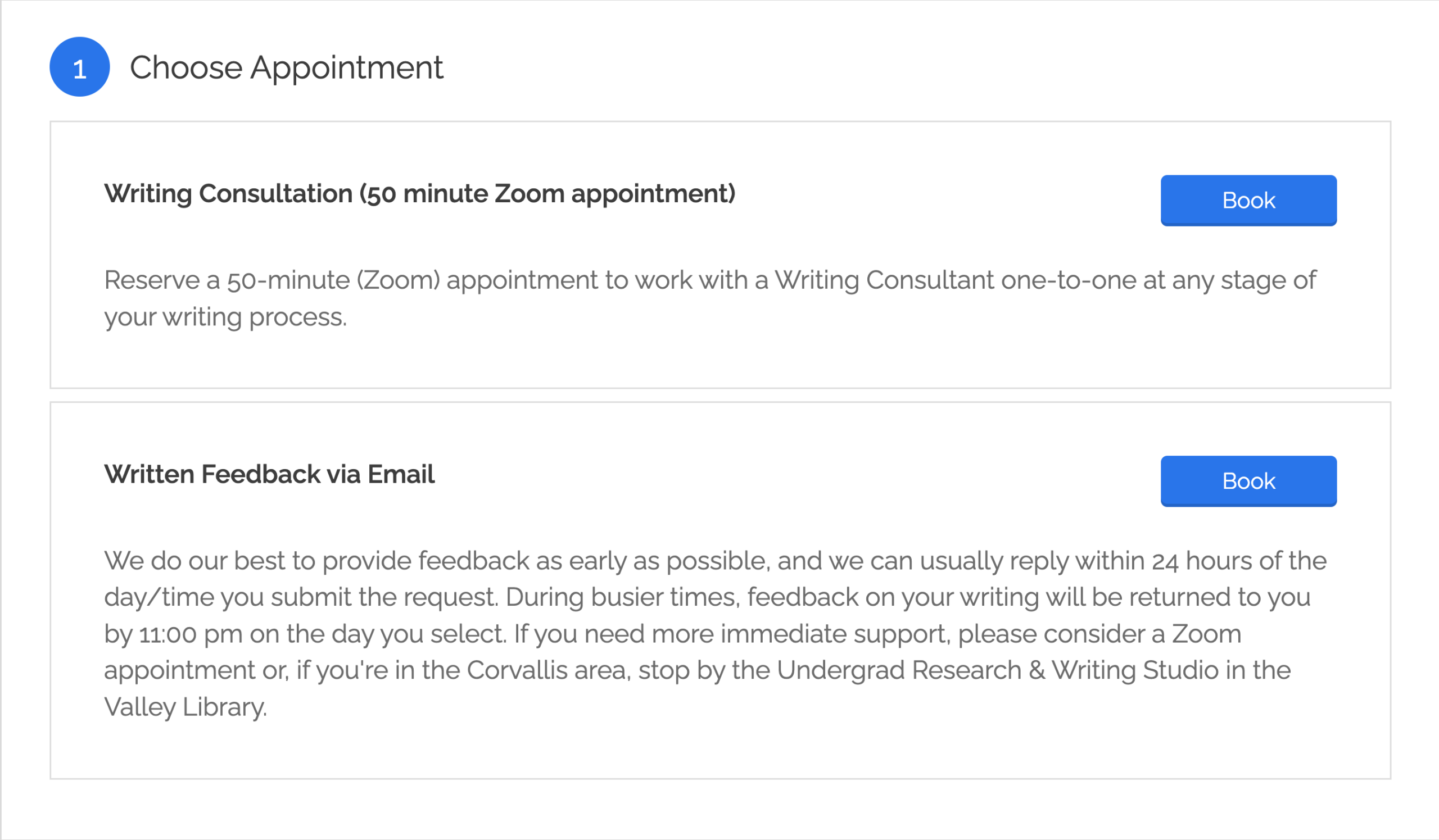
Online writing support center appointment options. 50 minute Zoom or written feedback via email

Ecampus students have access to a number of online resources to support their academic success at OSU. Receiving guidance and feedback on their writing assignments can be helpful across courses, throughout their planning and revision process. In this post, we will share more information about the current writing resources available to students, no matter where they are located, along with resources for faculty. OSU Writing Center The OSU Writing Center supports any type of writing project, during any stage of the writing process. Instructors can share this resource with students, or even integrate the writing center’s support as a step to receive guidance and feedback from a consultant in coordination with a class assignment. Online Writing Support (OWS) According to … Online Writing Support & Resources

Imagineering, Improvisation, and Instructional Design

In the 1980s, The Walt Disney Company rebranded its Disney Parks engineers as “imagineers,” and I think “instructional imagineering” would be a great rebranding of instructional design (if not for the copyright issue) because I often feel that the work I do is closer to engineering than design. Instructional designers are problem-solvers, but the work we do is not just problem-solving. It’s creative problem-solving, with each new project having new and specific challenges that often need a little imagination to solve–and a little improvisation. The history of the pedagogy of improvisation is traced back to the work of two women, Neva Boyd and Viola Spolin, working in Chicago in the 20s and 30s. Boyd was a sociologist doing social work … Imagineering, Improvisation, and Instructional Design

I got OpenAI’s ChatGPT to design an English language course

Note: This was conducted using the Jan 9 Pre Research Preview version of ChatGPT. Introduction ChatGPT has been featured everywhere recently, with some educators being particularly worried because of its ability to craft essays, provide answers to quiz questions, and bypass plagiarism detection software. Teachers are trying to find ways to detect AI generated content, but are we being too hasty to associate AI in education with academic misconduct? Could the tool being used to cheat on courses actually help build them? I put this to the test by asking ChatGPT some questions. Note: The purpose of this was to see how much of the course development process could be generated by the chatbot. How to begin? Let’s start at … I got OpenAI’s ChatGPT to design an English language course

Getting Experiential in Online and Hybrid Learning

The idea that students learn best when they have the opportunity to apply what they are learning to real-world contexts is the basis of Experiential Learning Theory (ELT). Learning by doing is at its core, and as a high-impact practice, there is increasingly more emphasis on experiential learning in higher education. There is plenty of evidence that supports the benefits of this type of learning. It affords students an opportunity to connect knowledge to authentic situations and increases learner autonomy, motivation, and overall satisfaction (Kolb and Kolb, 2018). Many OSU Ecampus Courses feature such experiences. In fact, OSU’s Honors College requires all courses to include experiential learning components, and this is increasingly the case across disciplines at OSU.  What does … Getting Experiential in Online and Hybrid Learning

Learning Outcomes: Do Students Even Read Them?

Learning outcomes (LOs) are used in instructional design to describe the skills and knowledge that students should have at the end of a course or learning unit, and to design assessments and activities that support these goals. It is widely agreed that specific, measurable outcomes are essential for planning instruction; however, some educators question the benefits of explicitly presenting them to students. I have been asked (and wondered myself): “What is the point of listing learning outcomes in the course?” “How do they help learning? “Do students even read them?” So, I went on a quest for research that attempted to answer such questions. I was particularly interested in unit/module-level outcomes, as those are the ones that directly steer the … Learning Outcomes: Do Students Even Read Them?