Once the term begins, you and your students enter into a full motion of course activities—getting connected with one another and moving along the education journey together. Then, when you realize it is the end of the term! I have heard many instructors saying things like “I can’t believe how fast this term has gone!”, “It’s already week 10, and I don’t know where time went!” And with the term at its conclusion, it is an opportunity to debrief, reflect, and take time for self-kindness, for both instructors and instructional designers.

Debrief

A debrief is an activity that helps close out the course development project. A debrief can help instructors more intentionally discuss how the course development process worked in a particular course, identify the challenges that took place while teaching, and outline future improvements and more effective course design approaches (Chatterjee, Juvale, & Jaramillo Cherrez, 2023). If you are an instructor who worked with an instructional designer to develop the course that you just finished teaching, it is important to meet with them and discuss how the course went, what worked well, what items presented challenges for students as well as for the instructors that immediate changes or improvements can be addressed as these are fresh in mind, and what major updates or changes are required before the course is taught again. These debriefs can take place during the last weeks of the term (e.g., finals week or the week after) and be initiated by the instructional designer as a way to close out the course development project, or by the instructor to seek additional instructional design assistance for improvements.

Reflection

Why would you want to reflect as an instructor? Generally speaking, reflection can serve as a mechanism to deliberately process and examine your actions, thoughts, and experiences in developing and teaching the course. For reflection after the term, we will focus on reflection-on-action, which is engaging in this deliberate process after the fact (Brookfield, 2017; Schön, 1987)—after you have taught the course. In reflecting about your course development and teaching experience at the end of the term, you may have the opportunity to not only describe what those experiences were like but also the opportunity to question and evaluate design and teaching choices, identify additional challenges presented in the context of the course, and reviewing student feedback to better understand the instructional design decisions that were successful and those that failed to accomplish your goals and the goals of the course. Reflection can be part of the debrief, but also a regular practice to look back at the course development and teaching experience for future improvements.

Self-Kindness

Self-kindness is not a new concept, but it may well be in the context of education. Applying this concept to your online course development and teaching experience means that you engage in kind actions to yourself—actions to treat yourself with care, compassion, and consideration (Denial, 2023). At the end of the term, as you debrief and/or reflect, think about the teaching actions that went well and consider how they made you feel. Give yourself grace and compassion because you are a human being and capable of so many great things, while acknowledging that the context and experiences may shape us in multiple ways. Also, because you have created an excellent online course and your teaching presence has elevated its quality. In exercising self-kindness, you may feel vulnerable as you may start recognizing the challenges and struggles in your academic and personal lives. Consider giving yourself the same compassion that you can give a loved one or a close friend, recognizing that the challenges, struggles, and failures are part of the human experience—even in teaching. Self-kindness is a way to direct your attention and actions away from judgments and shortcomings. Take care.

I’m curious, how do you conclude a term? Are there specific self-care actions that you take besides grading and submitting final grades?  

References

Brookfield, S. 2017. Becoming a critically reflective teacher. 2nd ed. Jossey-Bass

Chatterjee, R., Juvale, D., & Jaramillo Cherrez, N. (2023). What the debriefs unfold. A multicase study of their experiences of higher education faculty in designing and teaching their asynchronous online courses. The Quarterly Review of Distance Education, 24(1), 25-41.

Denial, C. J. (2024). A pedagogy of kindness. University of Oklahoma Press

Schön, D. A. 1987. Educating the reflective practitioner: Toward a new design for teaching and learning in the professions. Jossey-Bass

The saying “students may forget what we teach, but they’ll remember how we made them feel” is such an important idea that could help us start thinking about how to make online learning a space that fosters belonging, connection, respect for individual differences, and authentic participation. In support of instructional design practices and teaching approaches that can accomplish these aspects, online course design and teaching can be transformative for students (and instructors) when more human-centered strategies are built into the courses, strategies that go beyond cognitive tasks and challenges, and attend to the well-being of students and instructors. What if these practices and approaches are built upon kindness? Cate Denial’s (2024) “A Pedagogy of Kindness” invites us to explore ways in which we can do that.

In this first blog, I will share the foundational notion of “A Pedagogy of Kindness” and its main components. I will also offer a brief example to illustrate a step in applying this kind of pedagogy in an online course.

Denial’s View of Academia and Teaching

Kindness and Pedagogy

But what does kindness have to do with pedagogy and with online teaching and learning? The short answer is “everything.” Kindness helps to direct our attention, actions, and thoughts to being compassionate and considerate to those around us, physically and virtually. But what is kindness in the first place? Denial defines it in terms of what it is not: It is not about being nice because being nice is hypocritical, underscores power imbalances, presupposes a traditional view of rigor, and leads to burnout—all because of the efforts to disguise actions and thoughts as pleasant when they are less so. Kindness, instead, is a more genuine way to care for others—an approach that makes all see opportunities to bring equity, embrace accountability for our actions and thoughts, and remind ourselves that we live and thrive through compassion even in darker times.

Pedagogy of Kindness Framework

In the Pedagogy of Kindness framework, Denial presents three intersecting elements: a vision for justice, believing students, and believing in students. And these three elements point to considering students’ personal responsibilities, work commitments, financial obligations, disabilities, and attitudes toward the world around them (e.g., politics, climate change), and meet them where they are. In addition, Denial posits that “[w]e must take a hard look at what we’re asking students to do and then identify if there is value in it….If there is, we need to be able to explain that value to students as clearly and directly as we can.” (p 17) Denial’s framework for a pedagogy of kindness rests on three intersecting principles:

Justice: In this element, we should consider:

  • Who our students are
  • Give students the benefit of the doubt when something outlandish occurs
  • Believe in what students share about their educational experiences

Believe Students:

  • Cultivate trust
  • Be ready to deal with a situation or crisis rather than putting all under suspicion
  • Discuss with students ethical decisions

Believe in Students:

  • Students want to learn—they have creativity, capacity, and thoughtfulness
  • Establish collaboration for mutual learning

Pedagogy of Kindness in Online Education

This framework can be integrated into a course in multiple ways, through the teaching approach, syllabus, class practices, and overall interactions with students. For instance, in one online course I helped design, the language in the Artificial Intelligence policy said something to the effect of “If the assignment is written with AI, you will receive a zero.” In order to cultivate trust and help the instructor prepare to deal with any academic misconduct, we revisited the description of the policy, highlighting the value of students’ own work, ideas, and reflections. The policy language also acknowledged the challenges in completing the assignment and reinforced the importance of the learning process more than the product of the assignment. This example speaks to the believe students and believe in students elements of the pedagogy of kindness.

Now, how might you make kindness visible in your own online teaching?

A second part of this blog will provide examples and practical ways of how Pedagogy of Kindness grounded the design and facilitation of online courses.

References

Denial, C. J. (2024). A pedagogy of kindness. University of Oklahoma Press. 

Fall Term is just around the corner, bringing with it new opportunities, fresh faces, and the chance to make a lasting impact on your students. Whether they’re logging in for the first time or for their final term, setting a welcoming and engaging tone from day one helps create a foundation for everyone’s success, yours included.

Here are a few ways to kick things off and set the stage for a smooth, successful term:

Start with a warm welcome

  • Post a welcome announcement and introduce yourself to your students.
  • Use a warm and welcoming tone in your message to help students feel encouraged, supported, and comfortable as they enter the course.
  • Personalize it with a photo or short video, it goes a long way in making connections.

Open your course early

  • If possible, open your course before the official start date. This gives students a chance to explore, order materials, and introduce themselves.
  • Open modules at least two weeks ahead. Many students juggle full-time jobs, families, and other commitments, so maximum flexibility is appreciated.

Keep communication open

  • Set up a Q&A discussion forum, and check it regularly. This allows you to answer common questions once and ensures everyone sees the response.
  • Encourage students to post questions in this forum and let students know when and how they can expect replies.
  • Be responsive to messages and follow up with students if needed.

Model engagement

  • Join discussion boards and post regularly. Ask guiding questions, offer feedback, or simply cheer students on, show them you’re present and engaged.
  • Think about how you’d engage in a face-to-face class and bring that energy to your online space too.

Be accessible

  • Hold regular office hours or offer flexible scheduling options. Creating the time and space for students to connect with you makes a difference.

Grade consistently and give meaningful feedback

  • Timely, constructive feedback helps students grow. The effort you put in early pays off in improved work later in the term.

Stay organized

  • Block out time in your calendar each week for class check-ins and grading. A little planning now can prevent overwhelm and burnout later.

Take care of yourself

  • Don’t forget to breathe. Support your students by also supporting yourself.
  • Be kind to yourself and set boundaries to attend to personal commitments, too.

Here’s to a strong, successful Fall Term — you’ve got this!

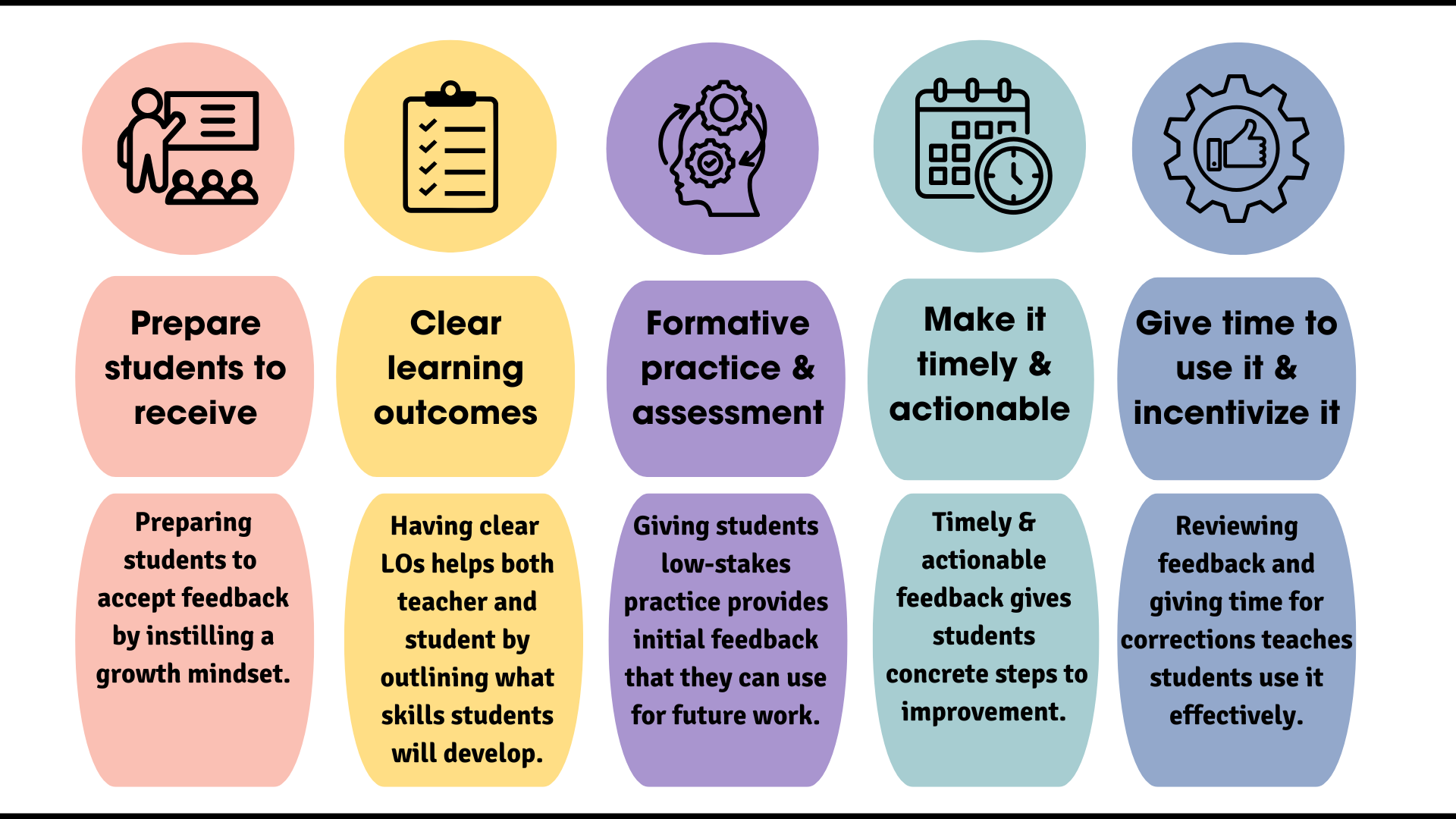
chart describing the steps in the feedback process

In part one of this two-part blog series, we focused on setting the stage for a better feedback cycle by preparing students to receive feedback. In part two, we’ll discuss the remaining steps of the cycle- how to deliver feedback effectively and ensure students use it to improve.

In part one, we learned about the benefits of adding a preliminary step to your feedback system by preparing students to receive suggestions and view them as helpful and valuable rather than as criticism. If you haven’t read part one, I recommend doing so before continuing. This first crucial but often overlooked step involves fostering a growth mindset and creating an environment where students understand the value of feedback and learn to view it as a tool for improvement rather than criticism. 

Step 2: Write Clear Learning Outcomes

The next step in the cycle is likely more familiar to teachers, as much focus in recent decades has been placed on developing and communicating clear, measurable learning outcomes when designing and delivering courses. Bloom’s Taxonomy is commonly used as a reference when determining learning outcomes and is often a starting point in backwards design strategy. Instructors and course designers must consider how a lesson, module, or course aligns with the learning objectives so that students are well-equipped to meet these outcomes via course content and activities. Sharing these expected outcomes with students, in the form of CLOs and rubrics, can help them to focus on what matters most and be better informed about the importance of each criterion. These outcomes should also inform instructors’ overall course map and lesson planning. 

Another important consideration is ensuring that learning outcomes are measurable, which requires rewriting unmeasurable ones that begin with verbs such as understand, learn, appreciate, or grasp. A plethora of resources are available online to assist instructors and course designers who want to improve the measurability of their learning outcomes. These include our own Ecampus-created Bloom’s Taxonomy Revisited and a chart of active and measurable verbs from the OSU Center for Teaching and Learning that fit each taxonomy level.

Step 3: Provide Formative Practice & Assessments

The third step reminds us that student learning is also a cycle, overlapping and informing our feedback cycle. When Ecampus instructional designers build courses, we try to ensure instructors provide active learning opportunities that engage students and teach the content and skills needed to meet our learning objectives. We need to follow that up with ample practice assignments and assessments, such as low-stakes quizzes, discussions, and other activities to allow students to apply what they have learned. This in turn allows instructors to provide formative feedback that should ideally inform our students’ study time and guide them to correct errors or revisit content before being formally or summatively graded. Giving preliminary feedback also gives us time to adjust our teaching based on how students perform and hone in on what toreview before assessments. Providing practice tests or assignments or using exam wrappers, exit cards, or “muddiest point” surveys to collect your students’ feedback can also be an important practice that can help us improve our teaching.

Step 4: Make Feedback Timely and Actionable

Step four is two-fold, as both the timeliness and quality of the feedback we give are important. The best time to give feedback is when the student can still use it to improve future performance. When planning your term schedule, it can be useful to predict when you will need to block off time to provide feedback on crucial assignments and quizzes, as a delay for the instructor equates to a delay for students. Having clear due dates, reminding students of them,  and sticking to the timetable by giving feedback promptly are important aspects of giving feedback.

To be effective, feedback must focus on moving learning forward. It should target the identified learning gap and suggest specific steps for the student to improve.. For a suggestion to be actionable, it should describe actions that will help the student do better without overloading them with too much information- choose a few actionable areas to focus on each time. Comments that praise students’ abilities, attitudes, or personalities are not as helpful as ones that give them concrete ways to improve their work.

Step 5: Give Time to Use Feedback and Incentive it

The last step in the cycle, giving students time to use the feedback provided, is often relegated to homework or ignored altogether. Feedback is most useful when students are required to view it and preferably do something with it, and by skipping this important step, the feedback might be ignored or glanced over perfunctorily and promptly forgotten. To close the loop, students must put the feedback to use. This can be the point where your feedback cycle sputters out, so be sure to make time to prioritize this final step. Students may need assistance in applying your feedback. Guiding students through the process, and providing scaffolds and models for using your feedback can be beneficial, especially during the initial attempts.

In my experience, it never hurts to incentivize this step: this can be as simple as adding points to an assignment for reflecting on the feedback given or giving extra credit opportunities around redone work. As a writing teacher, I required rewrites for work that scored below passing and offered to regrade any rewritten essays incorporating my detailed feedback. This proved to be a good solution, and while marking essays was definitely labor intensive, I was rewarded with very positive feedback from my students, often commenting that they learned a lot and improved significantly in my courses.

Considerations

A robust feedback cycle often includes opportunities for students to develop their own feedback skills by performing self-assessments and peer reviews. Self-assessment helps students in several ways, promoting metacognition and helping them learn to identify their own strengths and weaknesses. It also allows students to reflect on their study habits and motivation, manage self-directed learning, and develop transferable skills. Peer review also provides valuable practice honing their evaluative skills, using feedback techniques, and giving and receiving feedback, all skills they will find useful throughout adulthood. Both self-assessment and peer review give students a deeper understanding of the criteria teachers use to evaluate work, which can help them fine-tune their performance. 

Resources for learning more:

Feedback

Learning Outcomes

Self-assessment

Peer review

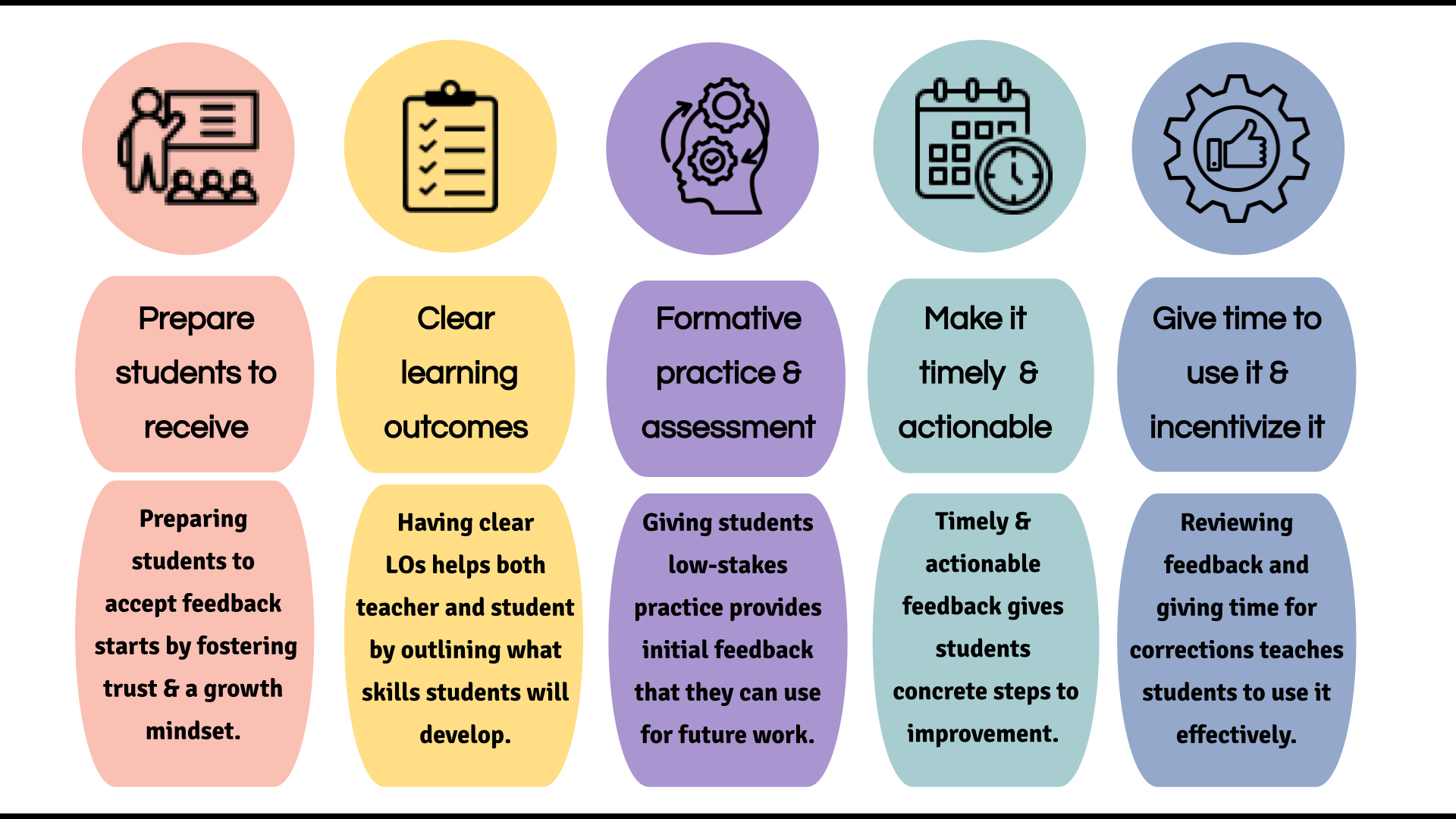
graphic image of the five steps in the feedback cycle

Giving and receiving feedback effectively is a key skill we all develop as we grow, and it helps us reflect on our performance, guide our future behavior, and fine-tune our practices. Later in life, feedback continues to be vital as we move into work and careers, getting feedback from the people we work for and with. As teachers, the most important aspect of our job is giving feedback that informs students how to improve and meet the learning outcomes to pass our courses.  We soon learn, however, that giving feedback can be difficult for several reasons. Despite it being one of our primary job duties as educators, we may have received little training on how to give feedback or what effective feedback looks like. We also realize how time-consuming it can be to provide detailed feedback students need to improve. To make matters worse, we may find that students don’t do much with the feedback we spend so much time providing. Additionally, students may not respond well to feedback- they might become defensive, feel misunderstood, or worse, ignore the feedback altogether. This can set us up for an ineffective feedback process, which can be frustrating for both sides. 

I taught ESL to international students from around the world for more than 10 years and have given a fair amount of feedback. Over many cycles, I developed a detailed and systematic approach for providing feedback that looked like this.

Gaps in this cycle can lead to frustration from both sides. Each step in the cycle is essential, so we’ll look at each in greater depth in this blog series. Today, we will focus on starting strong by preparing students to receive feedback, a crucial beginning that sets the stage for a healthy cycle.

Step 1: Prepare Students to Receive Feedback

An effective feedback cycle starts before the feedback is given by laying careful groundwork. The first and often-overlooked step in the cycle is preparing students to receive feedback, which takes planned, ongoing work. Various factors may influence whether students welcome feedback, including their self-confidence going into your course, their own self-concept and mindset as a learner, their working memory and learning capacity, how they view your feedback, and whether they feel they can trust you. Outside factors such as motivation and working memory are often beyond our control, but creating an atmosphere of trust and safety in the classroom can positively support students. Student confidence and mindset are areas in which  teachers can play a crucial supporting role. 

Researcher Carol Dweck coined the term “growth mindset” after noticing that some students showed remarkable resilience when faced with hardship or failure. In contrast, others tended to easily become frustrated and angry, and tended to give up on tasks. She developed her theory of growth vs. fixed mindsets to explain and expound on the differences between these two mindsets. The chart below shows some of the features of each extreme, and we can easily see how a fixed mindset can limit students’ resilience and persistence when faced with difficulties. 

graphic of brain with growth mindset hallmarks on the left and fixed mindset ideas on the right.

Mindset directly impacts how students receive feedback. Research has shown that students who believe that their intelligence and abilities can be developed through hard work and dedication are more likely to put in the effort and persist through difficult tasks, while those who see intelligence as a fixed, unchangeable quality are more likely to see feedback as criticism and give up. 

Developing a growth mindset can have transformative results for students, especially if they have grown up in a particularly fixed mindset environment. People with a growth mindset are more likely to seek out feedback and use it to improve their performance, while those with a fixed mindset may be more likely to ignore feedback or become defensive when receiving it. Those who receive praise for their effort and hard work, rather than just their innate abilities, are more likely to develop a growth mindset. This is because they come to see themselves as capable of improving through their own efforts, rather than just relying on their natural talents. A growth mindset also helps students learn to deal with failure and reframe it positively. It can be very difficult to receive a critique without tying our performance to our identity. Students must  have some level of assurance that they will be safe taking risks and trying, without fear of being punished for failing. 

Additionally, our own mindset affects how we view student effort, and we often, purposefully or not, convey those messages to students. Teachers with growth mindsets have a positive and statistically significant association with the development of their students’ growth mindsets. Our own mindset affects the type of feedback we are likely to provide, the amount of time we spend on giving feedback, and the way we view the abilities of our students. 

These data suggest that taking the time to learn about and foster a growth mindset in ourselves and our students results in benefits for all. Teachers need to address the value of feedback early on in the learning process and repeatedly throughout the term or year, and couching our messaging to students in positive, growth-oriented language can bolster the feedback process and start students off on the right foot, prepared to improve. 

Here are some concrete steps you can take to improve how your students will receive feedback:

  • Model a growth mindset through language and actions 
  • Include growth-oriented statements in early messaging
  • Provide resources for students to learn more about growth vs. fixed mindsets
  • Discuss the value of feedback and incorporate it into lessons
  • Create an atmosphere of trust and safety that helps students feel comfortable trying new things 
  • Teach that feedback is NOT a judgment of the person, but rather a judgment on the product or process
  • Ensure the feedback we give focuses on the product or process rather than the individual
  • Praise effort rather than intelligence
  • Make it clear that failure is part of learning and that feedback helps improve performance
  • Provide students with tools and strategies to plan, monitor, and evaluate their learning 

Resources for learning more about growth mindset and how it relates to feedback:


Stay tuned for part 2, covering the remaining steps in the feedback cycle. 

One of my favorite design strategies is to make a small adjustment that delivers a big impact. When it comes to creating a welcoming online course, certain small adjustments can do just that and go a long way in warming up the online classroom. But first, let us look at why online courses ought to be welcoming and then what it means to be welcoming in the online space.

Why Welcoming Students Is Important

First, why is it important to design a welcoming course? According to the OSU Ecampus Online Teaching Principles, which are supported by research and endorsed by Quality Matters, it is recommended to “[m]ake facilitation choices that support diverse students and make each student feel welcomed and valued.” Additionally, specific review standard 1.8 from the Quality Matters Higher Education Rubric, 7th Edition, states that “The self-introduction by the instructor is welcoming and is available in the course site.” Furthermore, UDL 3.0 Guidelines were updated recently and include “Design Options for Welcoming Interests & Identities.” While all of those are evidence-based recommendations, I think it is safe to say that many faculty also have plenty of anecdotal evidence for the benefits to students when feeling welcome in a course. If one has been working in the higher education context for several years, it is easy to forget that many students struggle to feel that they belong in this context. Warm communication and greetings is one way to begin connecting with students who are skeptical that their experience matters or that their presence is valued. 

What Does It Mean To Be Welcoming?

Next, let’s look at what it means to be welcoming in the online classroom. If we get down to basics and turn to a dictionary definition, we see that Merriam-Webster has defined welcoming as “to greet hospitably and with courtesy and cordiality; to accept with pleasure the occurrence or presence of.” For the online modality then, we can ask ourselves some questions: Where in the course can facilitators greet students? When students inquire about office hours or email with a question, can their presence be warmly accepted? Next let’s look at actions that faculty or other course facilitators, such as graduate teaching assistants, can take to be welcoming.

 Creating a Welcoming Online Classroom

The following tips are just a few of the actions that can be taken to create a welcoming online classroom:

  • Greet each student in the introduction discussion. Replying to each student is one of those actions that is small but has a big impact. 
  • Many online students are older than the traditional college age, so they often have extensive work experience and life experiences to draw upon. Acknowledging this life experience can go a long way in welcoming students. 
  • Rename office hours to something like Coffee Chat, Afternoon Tea, or Q&A Hour. Here is an example to consider: Which description of office hours sounds more welcoming, Example 1 or Example 2? Example 1: “Office Hours are held by appointment. Please email to make an appointment.” Let’s compare that to Example 2: “Please join me for a Coffee Chat this term! Coffee Chats are held three times per term, as an open Zoom room for our class. If you can’t attend any of the scheduled Coffee Chats, please email me and schedule a time to meet. I want to get to know each of you. Furthermore, when I get to know students, I am better positioned to serve as a reference for educational or professional opportunities that come up in our field. I look forward to meeting with you!”
  • Consider how students are described in the course site. Alternative descriptions besides “students” could be fellow scholars, colleagues, participants, etc.
    • Consider these two different introduction discussion prompt designs, 1 and 2:
      • Design 1: “Students: Post an introduction that includes the following: Your major and why you are taking this course. Reply to two other students.”
      • Design 2 (designed to be more welcoming): “Welcome, fellow engineering scholars! Please introduce yourselves so that we may all begin to get to know each other. In your post, include 1) an educational or professional goal that you have connected to this course, 2) a time management tip that you have found helpful that you are willing to share with others, and 3) a photo or fun fact about yourself. Replies to other participants are optional but encouraged.”
  • Ecampus Online Teaching Principles, endorsed by Quality Matters, recommend “referring to each student by name with their chosen pronouns.” Sometimes students who use a shortened nickname will say so in their introductory post, but it is also nice to include instructions for students on how to change their display name in the course site. That way, facilitators of the course, including graduate teaching assistants, if applicable, do not have to refer back to the introduction post to remember what students prefer to be called.

Takeaway

Adding a welcoming tone to a course does not mean that the whole course needs to be redesigned. A few small adjustments here and there can make a difference.

Recommended Readings for Further Interest

As we design and plan the facilitation of our online courses, identifying strategies that help to foster an inclusive learning environment is essential. One effective strategy to achieve this goal is through proactive outreach, which helps to build strong relationships and ensure that all students receive the support they need to succeed.

Canvas provides a variety of tools that make it easier and quicker to connect directly with students who need support. In this post, we will look at a component of the Gradebook called the “Message Students Who” feature.

This messaging feature is a tool that allows instructors to send targeted messages to students based on specific criteria. Targeted, proactive messages not only enhance engagement but also align with the principles of inclusive design by addressing the diverse needs of students in a timely and personalized manner.

Accessing the Message Students Feature From the Canvas Gradebook

See the steps below for a guide on how to access this feature and the options available.

Open Gradebook

In Course Navigation, click the Grades link.

Open Gradebook

Open Assignment Menu

Hover the cursor over the assignment or assignment group column header and click the Options icon.

Open Assignment

Message Students

Click the Message Students Who link to open a message.

Message Students

View Compose Message

In the Compose Message window, you can select a category of students to message [1], manage the recipients [2], enter a message title [3], and compose a message [4].

View Compose Message

Message Students Who…

You can choose from several categories to message students:

  • Have not yet submitted: Students who haven’t submitted the assignment.
  • Have not been graded: Students whose assignments have not yet been graded.
  • Scored less than [point value]: Students who earned a grade on their assignment less than a specified number of points.
  • Scored more than [point value]: Students who earned a grade on their assignment more than a specified number of points.
  • Reassigned: Students who have submitted an assignment and you have reassigned it to them.

Although one message will be sent to multiple students at the same time, each student will receive an individual message. This helps to build the relationship you have with each student, and provides them a 1-1 space to share personal concerns or needs with you.

Considerations

It’s important to be intentional with proactive outreach and consider the tone and wording when messaging students using this tool. Offering empathy and using inclusive language will help encourage students to be responsive and stay engaged with the course.

There may be information shared that requires a referral for additional student support. Faculty can reach out to Ecampus Faculty Support or Ecampus Student Services for support in identifying the correct referral.

Benefits of Proactive Outreach

  1. Timely Interventions: By identifying students who are struggling or falling behind, you can intervene early. This can prevent minor issues from becoming major obstacles to their success.
  2. Personalized Support: Tailoring your messages to address specific concerns shows students that you are attentive to their needs, which can boost their motivation and engagement. Students are more likely to utilize resources and ask for help when needed, knowing that you are present and available.
  3. Increased Engagement: Regular communication helps maintain connection and strengthens the relationship between instructors and students. The Ecampus student population is largely made up of working adults, who have dependents and outside responsibilities. Your touching base helps to encourage them to stay active and engaged in the course.

Students have shared feedback in past annual surveys that some of the most impactful experiences they had as an online student at OSU were related to their instructor reaching out to them in a time of need. The “Message Students Who” tool in Canvas helps to lower the barrier of time for faculty to reach students in need and offer their support. For more information on this tool, please see the Canvas guide: How do I send a message to students from the Gradebook?

Resources

  1. Ecampus Online Teaching Principles
  2. Improving Student Engagement and Connection in Online Learning through Proactive Support (CDT Blog)
  3. Demonstrating Care: Reach Out and Refer (CDT Blog)
  4. Behind the Buzzword: Creating Belonging For Online Students at OSU (CDT Blog)
  5. Infographic: 4 Ways To Proactively Support Online Students
  6. Canvas Guide: How do I send a message to students from the Gradebook?

The idea of creating equitable learning environments is at the core of inclusive practices. Many educators argue that equitable learning environments are essential for student success, but what does this mean in practice? Inclusive practices build upon the premise that design and teaching should adapt to support students’ unique needs, fostering student agency. Student-centered approaches prioritize equity over equality. It’s crucial to understand that equity, which tailors resources and opportunities to individual needs, fundamentally differs from equality, which assumes that students should receive the same treatment and that this treatment is thus fair for all.

Equity refers to the “removal of systemic barriers and biases (e.g., policies, processes, outcomes), enabling all individuals to have equal opportunity to access and benefit from resources and opportunities.” (University of Waterloo, n.d.). Equity in online learning means removing barriers to participation. This is especially true for underrepresented groups, first-generation students, and those with different learning styles. Barriers include accessing materials, completing assignments, and interacting with peers and instructors. Applying an equity lens to online and hybrid design and facilitation involves many factors. Among these, structure, flexibility, and feedback are particularly critical. In this post, we will explore these elements from the perspective of the course as a whole. This will set the stage for a deeper examination of these same elements at the assessment level in my next blog post. Stay tuned!

Structure

  • Provide short descriptions for each learning material and their value in the learning process. What do students gain from reading or watching the required material for the remaining activities? 
  • Include a purpose statement in each assignment and how it contributes to learning and achieving outcomes. How are the assessments connected to the overall goal of the course? 
  • Design assessments that promote active learning, higher-order thinking, and student agency. How are students involved in the learning process? How do students apply concepts? Do assessments reflect meaningful personal experiences?   
  • Make the module content, format, and requirements consistent. How are students expected to participate in discussions? Are there activities that can benefit students from peer learning and interaction? For example, create spaces for students to collaborate and support each other beyond the traditional discussion boards.
  • Build in multimodalities for content and assessments. What are the skills that are being asked in the assignment (e.g., emphasize writing or deepening concept understanding)? Are there other ways in which students can demonstrate their learning?  For example, rather than a written paper, consider allowing students to submit an audio recording, a multimedia presentation, a collage, etc.
  • Provide a clear course schedule with regular milestones and check-in points to support learning. For instance, incorporate scaffolding into course activities and assessments with low-stakes and formative assessments.

Flexibility

While a clear and robust course structure is essential for guiding students through the learning process, it’s equally important to recognize the role flexibility plays in supporting diverse learners. Flexibility does not mean a lack of academic integrity or rigor. Flexibility can mean many things for many people therefore, it is important to clarify its intention, meaning, and place in the course. The most common use of flexibility in the online classroom is for extensions on assignments, which can help reduce instructor bias and increase student engagement and agency (Ruesch & Sarvary, 2023). How else can flexibility be incorporated into an online course? Following, there are a few ideas and questions to guide the decision about flexibility:

  • Consider updating late submission policies. Ensure that students know what to expect if unforeseen circumstances prevent them from submitting assignments by the due date. Be cognizant that life happens to everyone, and we need to offer kindness and empathy to students. How can an “automatic” late assignment policy work within the nature and scope of the course?
  • In selecting materials, identify multiple formats students can use to gain knowledge. Are there media-based materials that provide the textbook content in an alternative way (e.g., audiobook, ebook)?
  • Design assignments that include choice for students to select the format or topic of their preference. Do assignments need to all be written? Where can students choose their own topic for a project?

Feedback

While structure and flexibility are essential components of an inclusive learning environment, they alone are insufficient. Research suggests that instructor presence is fundamental to developing a sense of belonging and connection in the online environment. In addition, instructor feedback is as critical as presence to promote learning. Instructor feedback can help students identify the areas to improve. It can also help instructors identify additional resources to support students. Providing students feedback is mutually beneficial. Students receive actionable feedback on their progress and instructors learn what works in the course and what to improve. Let’s explore some ideas for feedback as a framework to build a connection with students:

  • Create feedback guidelines that communicate to students what to expect from you and when. When will assignments be graded and grades reported? How soon will you respond to email questions?
  • Consider offering feedback in multiple formats, such as audio or video in addition to text. Reflect on which activities might benefit from the added context and personal connection audio/video feedback would provide?
  • Prepare rubrics or grading guidelines that clearly indicate to students how the assignments will be graded. Ensure the rubrics are connected to the purpose and expectations of the assignments.
  • Give students actionable feedback that shows students their learning progress and guides them on how to improve.
  • Design the course modules to include feedback and revision steps. This approach will help students see how all course components are connected and contribute to meeting the course outcomes.
  • Include peer feedback (peer review) that 1) gives students guidance on how to conduct a peer review, and 2) enhances their critical thinking and perspectives by reading peers’ work.

Educators can move away from a one-size-fits-all approach by intentionally combining structure, flexibility, and feedback. This creates an environment that addresses the diverse and unique needs of all students and ensures every student has an equal opportunity to succeed, regardless of where they start.

References

  • Eddy, S. L., & Hogan, K. A. (2014). Getting under the hood: how and for whom does increasing course structure work?. CBE life sciences education, 13(3), 453–468. https://doi.org/10.1187/cbe.14-03-0050
  • Ruesch, J. M., & Sarvary, M. A. (2024, March). Structure and flexibility: systemic and explicit assignment extensions foster an inclusive learning environment. In Frontiers in Education (Vol. 9, p. 1324506). Frontiers Media SA.
  • University of Waterloo (n.d.). Humanizing Virtual Learning. https://ecampusontario.pressbooks.pub/humanizinglearningonline/


This image is part of the Transformation Projects at the Ars Electronica Kepler's Garden at the JUK. The installation AI Truth Machine deals with the chances and challenges of finding truth through a machine.

All the buzz recently has been about Generative AI, and for good reason. These new tools are reshaping the way we learn and work. Within the many conversations about Artificial Intelligence in Higher Ed a common thread has been appearing regarding the other AI–Academic Integrity. Creating and maintaining academic integrity in online courses is a crucial part of quality online education. It ensures that learners are held to ethical standards and encourages a fair, honest, and respectful learning environment. Here are some strategies to promote academic integrity and foster a culture of ethical behavior throughout your online courses, even in the age of generative AI.

Create an Academic Integrity Plan

Having a clear academic integrity plan is essential for any course. Create an instructor-only page within your course that details a clear strategy for maintaining academic integrity. This plan might include a schedule for revising exam question banks to prevent cheating, as well as specific measures to detect and address academic dishonesty (plagiarism or proctoring software). In this guide, make note of other assignments or places in the course where academic integrity is mentioned (in the syllabus and/or particular assignments), so these pages can be easily located and updated as needed. By having a plan, you can ensure a consistent approach across the course.

Exemplify Integrity Throughout the Course

It is important to weave academic integrity into the fabric of your course. Begin by introducing the concept in your Start Here module. Provide an overview of what integrity means in your course, including specific examples of acceptable and unacceptable behavior. This sets the tone for the rest of the course and establishes clear expectations. On this page, you might:

  • Offer resources and educational materials on academic integrity for learners, such as guides on proper citation and paraphrasing.
  • Include definitions of academic dishonesty, such as plagiarism, cheating, and falsification.
  • Provide guidance on how learners might use generative AI within the class, including what is and is not considered acceptable.
  • Add scenarios or case studies that allow learners to discuss and understand academic integrity issues, specifically related to the use of generative AI.
  • Connect academic integrity with ethical behavior in the larger field.
  • Provide a place for learners to reflect on what it means for them to participate in the course in a way that maximizes their learning while maintaining academic integrity.

Throughout the course, continue to reinforce these ideas. Reminders about academic integrity can be integrated into various lessons and modules. By articulating the integrity expectations at the activity and assignment level, you provide learners with a deeper understanding of how these principles apply to their work. 

Set Clear Expectations for Assignments

When designing assignments, it is important to be explicit about your expectations for academic integrity. Outline what learners should and should not do when completing the task. For instance, if you do not want them to collaborate on a particular assignment, state that clearly. Provide examples and resources to guide learners on how to properly cite sources or avoid plagiarism. Be specific with your expectations and share why you have specific policies in place. For instance, if you want to discourage the use of generative AI in particular assignments, call out the ways it can and cannot be used. As an example, you might tell learners they can use generative AI to help form an outline or check their grammar in their finished assignment, but not to generate the body text. Share the purpose behind the policy, in this case it might be something about how a writing assignment is their opportunity to synthesize their learning and cement specific course concepts. This kind of transparency shows respect for the tools and the learning process, while also clearly outlining for learners what is acceptable.

Encourage Conversations About Integrity

Creating opportunities for learners to engage in discussions about academic integrity can help solidify these concepts in their minds. You can incorporate forums or discussion boards where learners can share their thoughts and experiences related to integrity. This also gives them a chance to ask questions and seek clarification on any concerns they may have. Encourage open dialogue between instructors and learners regarding academic integrity and any related concerns. These conversations can also extend beyond the classroom, exploring how integrity applies in your field or career paths. By connecting academic integrity to real-world scenarios, you help learners understand its relevance and importance in their professional lives.

Foster a Supportive Learning Environment

A supportive learning environment can help reinforce academic integrity by making learners feel comfortable asking questions and seeking guidance. Offer resources like definitions, guides, or access to mentors who can provide additional support. When learners know they have access to help, they are more likely to adhere to integrity standards. With generative AI in the learning landscape, we will inevitably encounter more “gray areas” in academic integrity. Be honest with your learners about your concerns and your hopes. Being open to conversations can only enhance the learning experience and the integrity in your courses.

We all play a role in cultivating a culture of academic integrity in online courses. By documenting a clear plan, weaving integrity into the course content, setting clear expectations, encouraging conversations, and providing support, you can create an environment where honesty and ethical behavior are valued and upheld. This not only benefits learners during their academic journey but also helps them develop skills and values that will serve them well in their future careers.

I was recently reminded of a conference keynote that I attended a few years ago, and the beginning of an academic term seems like an appropriate time to revisit it on this blog.

In 2019, Dan Heath, a bestselling author and senior fellow at Duke University’s CASE Center, gave a presentation at InstructureCon, a conference for Canvas users, where he talked about how memories are formed. He explained that memories are composed of moments. Moments, according to Heath, are “mostly forgettable and occasionally remarkable.” To illustrate, most of what I’ve done today–dropping my kids off at spring break camp, replying to emails, going to a lunchtime yoga class, and writing this blog post–will largely be forgotten by next month. There is nothing remarkable about today. Unremarkable is often a desirable state because it means that an experience occurred without any hiccups or challenges.

Heath went on to describe what it is that makes great experiences memorable. His answer: Great experiences consist of “peaks,” and peaks consist of at least one of the following elements: elevation, insight, pride, or connection. He argued that we need to create more academic peaks in education. Creating peaks, he contends, will lead to more memorable learning experiences.

So, how do we create these peaks that will lead to memorable experiences? Let’s explore some ideas through the four approaches outlined by Heath.

Elevation. Elevation refers to moments that bring us joy and make us feel good. You might bring this element into your course by directly asking students to share what is bringing them joy, perhaps as an icebreaker. Sharing their experiences might also lead to connection, which is another way (see below) to create peaks that lead to memorable experiences. 

Insight. Insight occurs when new knowledge allows us to see something differently. Moments of insight are often sparked by reflection. You might consider making space for reflection in your courses. Creativity is another way to spark new insights. How might students engage with course concepts in new, creative ways? To list off a few ideas, perhaps students can create a meme, record a podcast, engage in a role play, or write a poem.

Pride. People often feel a sense of pride when their accomplishments are celebrated. To spark feelings of accomplishment in your students, I encourage you to go beyond offering positive feedback and consider sharing particularly strong examples of student work with the class (after getting permission–of course!) Showcasing the hard work of students can help students to feel proud of their efforts and may even lead to moments of joyful elevation.

Connection. Connection refers to our ties with other people. Experiencing connection with others can feel deeply rewarding. As I mentioned above, asking students to share their experiences with peers is one way to foster connection. In Ecampus courses, we aim to foster student-student and student-teacher connection, but I encourage you to explore other opportunities for students to make meaningful connections. Perhaps students can get involved with their communities or with colleagues, if they happen to have a job outside of classes. Students could connect with their academic advisors or the writing center to support their work in a course. There are many ways to foster connections that support students in their learning!

It’s easy to focus on delivering content, especially in online courses. This was one of Heath’s overarching points. The key, however, to creating memorable learning experiences is to take a student-centered approach to designing and facilitating your course. 

I invite you to start the term off by asking yourself: How can I create more moments of elevation, insight, pride, and connection for my students? It might be easier than you think.

References:

Heath, D. (2019, July 10). Keynote. InstructureCon. Long Beach, CA.