
Inspire Blog Category: Course Design/Learning Design

Universal Design for Learning in Online Courses
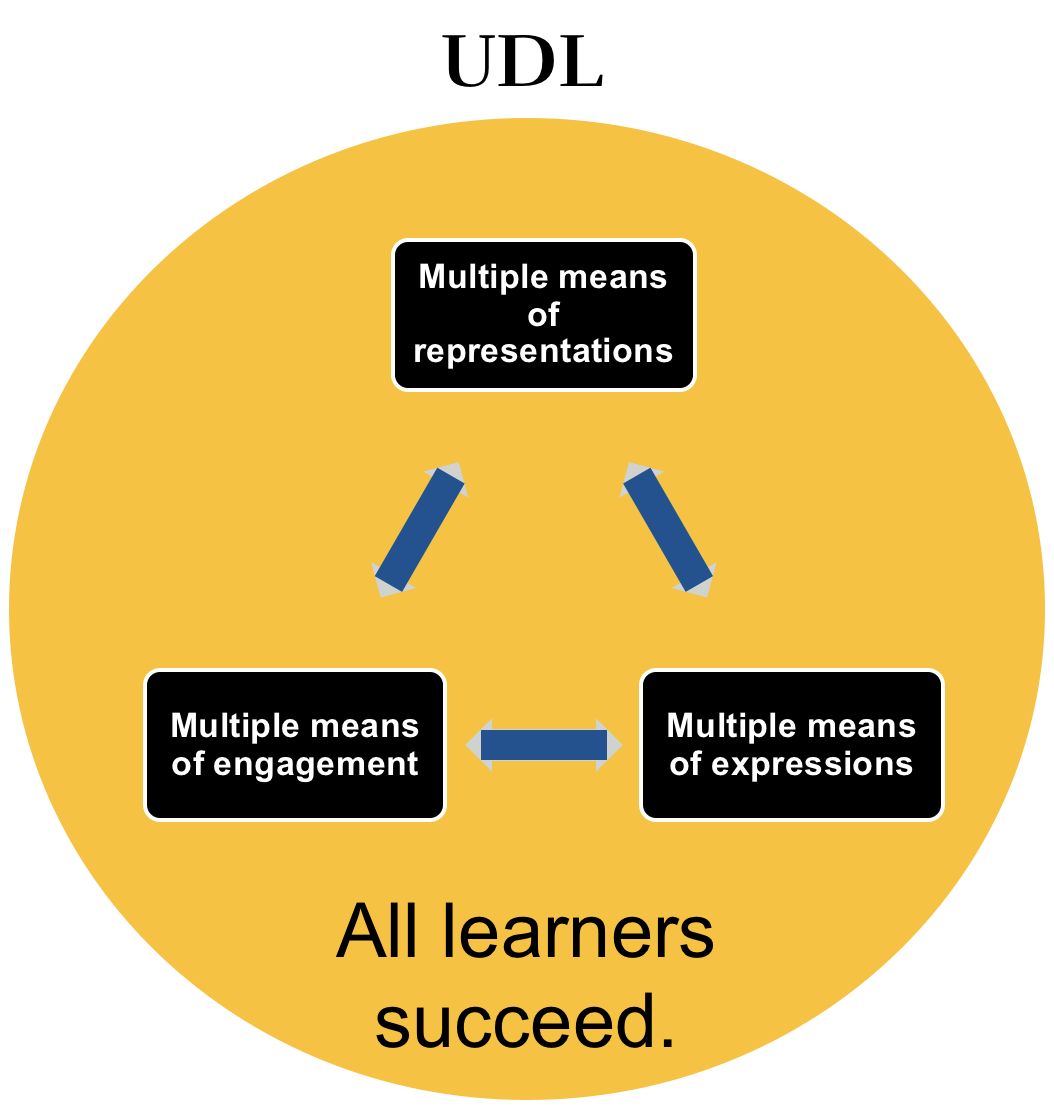
UDL

Universal Design for Learning (UDL) is a practical tool for guiding course design to ensure that every learner succeeds, based on scientific insights into how humans learn (cast.org). As seen from the illustration below, there are three main principles of UDL, namely: multiple means of representations, multiple means of engagement, and multiple means of expressions (image by Tianhong Shi, CC0) There are many applications of UDL design principles in OSU Spring 2018 online courses. A. Multiple Means of Representations as seen in BA 354 S18’s weekly content planning. reading in text (Chapter 1 of Trevino and Nelson, Managing Business Ethics) listening to podcast (Ponzi Supernova podcast audio from Radio-lab watching instructor lectures in video (Course Introduction) Watching complicated assignment explained … Universal Design for Learning in Online Courses

Active Learning Online – Part 1

Are you looking for ways to bring active learning into your online classroom? Some might suggest that active learning is more difficult online, but we offer examples of Ecampus courses that do a great job of increasing student engagement, boosting interactive participation, and improving outcomes through implementation of active learning strategies. This blog focuses on tools, techniques, and approaches originally designed for the face-to-face classroom that have been successfully adapted into Oregon State University Ecampus classes. Feel free to steal! Telling Time Marking events in time or identifying the chronology of significant milestones is important in many disciplines, but especially vital in history classes. An American History professor felt that merely listing events sequentially was not particularly interesting or creative, … Active Learning Online – Part 1

Humanizing Online Learning

Why should I care about humanizing online learning? First of all, the United States Department of Education requires regular and substantive interaction between students and faculty in distance learning courses (Policy from DOE & interpreting the Policy from DOE). Secondly, it is well documented that instructor-student interactions and quality and timely instructor feedback in online learning are prominent faculty behaviors that impact student retention and student satisfaction of online learning (Riedel, Dinauer, Jobe, Lenio, And Walsh, 2016; Bawa, 2016; Shaw, Burrus, Ferguson, 2016; Boling, Hough, Krinsly, Saleem and Stevens, 2012; Liaw, 2008). How do we humanize online learning? Think of the task for humanizing your students’ online learning experience as building a house. And there are three major pillars to … Humanizing Online Learning

Quality DOES Matter

What is QM? You may know that OSU is a subscribing member of Quality Matters (QM), a nationally-recognized program focused on online learning course design. Its mission is to measure and guarantee the quality of an online course. QM uses research findings to recommend best practices in online course design. As an instructional designer (ID), I use and apply the QM rubric and quality assurance principles when working with faculty to design Ecampus courses. About a year ago, I took the first QM workshop, called Applying the QM Rubric or APPQMR. By the way, this excellent training is offered through Ecampus each quarter. If you haven’t yet participated, take advantage of it. For more information, contact Karen Watte. Not Just … Quality DOES Matter

The Right Communication Plan for your Online Course

Online courses are open 24/7. This is more convenient for students, but it also means they don’t really know how/when to get in touch with you, the instructor. Online courses benefit greatly when the instructor creates a communication plan and communicates it with their students, especially in weeks one and two of the term. Here’s a sample communication plan: “Please post questions about the course in the Q&A discussion forum so that the entire class can benefit from our back-and-forth. Please reserve email for questions of a personal nature. I will reply to email and questions posted in the Q&A discussion forum within 24 hours, usually sooner.  I strive to return all graded work, with my feedback, within 5 days … The Right Communication Plan for your Online Course