
Inspire Blog Tag: active learning

Getting Experiential in Online and Hybrid Learning

The idea that students learn best when they have the opportunity to apply what they are learning to real-world contexts is the basis of Experiential Learning Theory (ELT). Learning by doing is at its core, and as a high-impact practice, there is increasingly more emphasis on experiential learning in higher education. There is plenty of evidence that supports the benefits of this type of learning. It affords students an opportunity to connect knowledge to authentic situations and increases learner autonomy, motivation, and overall satisfaction (Kolb and Kolb, 2018). Many OSU Ecampus Courses feature such experiences. In fact, OSU’s Honors College requires all courses to include experiential learning components, and this is increasingly the case across disciplines at OSU.  What does … Getting Experiential in Online and Hybrid Learning
Project-based Learning (Part 3) – Practical Preparation

Ashlee M. C. Foster, MSEd | Instructional Design Specialist | Oregon State University Ecampus This is the final installment of a three-part series on project-based learning. The first two articles, Architecture for Authenticity and Mindful Design, explore the foundational elements of project-based learning. This article shifts our attention to generating practical application ideas for your unique course. This series will conclude with a showcase of an exemplary Ecampus course project.  Over the last couple of years, as an instructional designer, I have observed my faculty developers shifting how they assess student learning. Frequent and varied low-stakes assessments are replacing high-stakes exams, in their courses. Therefore, students increasingly have more opportunities to actively engage in meaningful ways. What an exciting time! … Project-based Learning (Part 3) – Practical Preparation

Boost Your Student Engagement with Qualtrics: An Overview

Instructors and course designers often use quizzes or forms for assessment, retrieval practice, self-checks, or collecting information from students. Did you know that Qualtrics surveys can take your interaction game to an even higher level of sophistication? Qualtrics surveys can easily be linked to or embedded in a page in your Learning Management System. They can also be added as an assignment through the LTI integration. The LTI integration has recently become an available feature for Oregon State University Canvas users. The integration links the survey to the student’s LMS account and is useful for awarding points automatically for completing the survey. In addition, several types of questions can be scored; thus, a survey can be used as a quiz … Boost Your Student Engagement with Qualtrics: An Overview

Let’s Get Active: Adding Active Learning in Your Online Course

By Susan Fein, Instructional Designer, susan.fein@oregonstate.edu In my role as an instructional designer, the faculty I work with are often looking for ways to increase student engagement and add a “wow” factor to their online course. One way to do that is to add or increase active learning practices. Active learning requires students to do something and think about what they are doing, rather than simply listening, as with a passive-learning lecture (Bonwell & Eison, 1991). Active learning brings positive and lasting outcomes to students, including better retention and grasp of concepts, and is particularly evident when students work together to develop solutions (Chickering & Gamson, 1987). Tackling Discussions In 2019, I worked with an instructor developing a biochemistry/biophysics course … Let’s Get Active: Adding Active Learning in Your Online Course

Adding a New Feedback Loop to Your Online Courses

Canvas Survey with Mud Card Questions

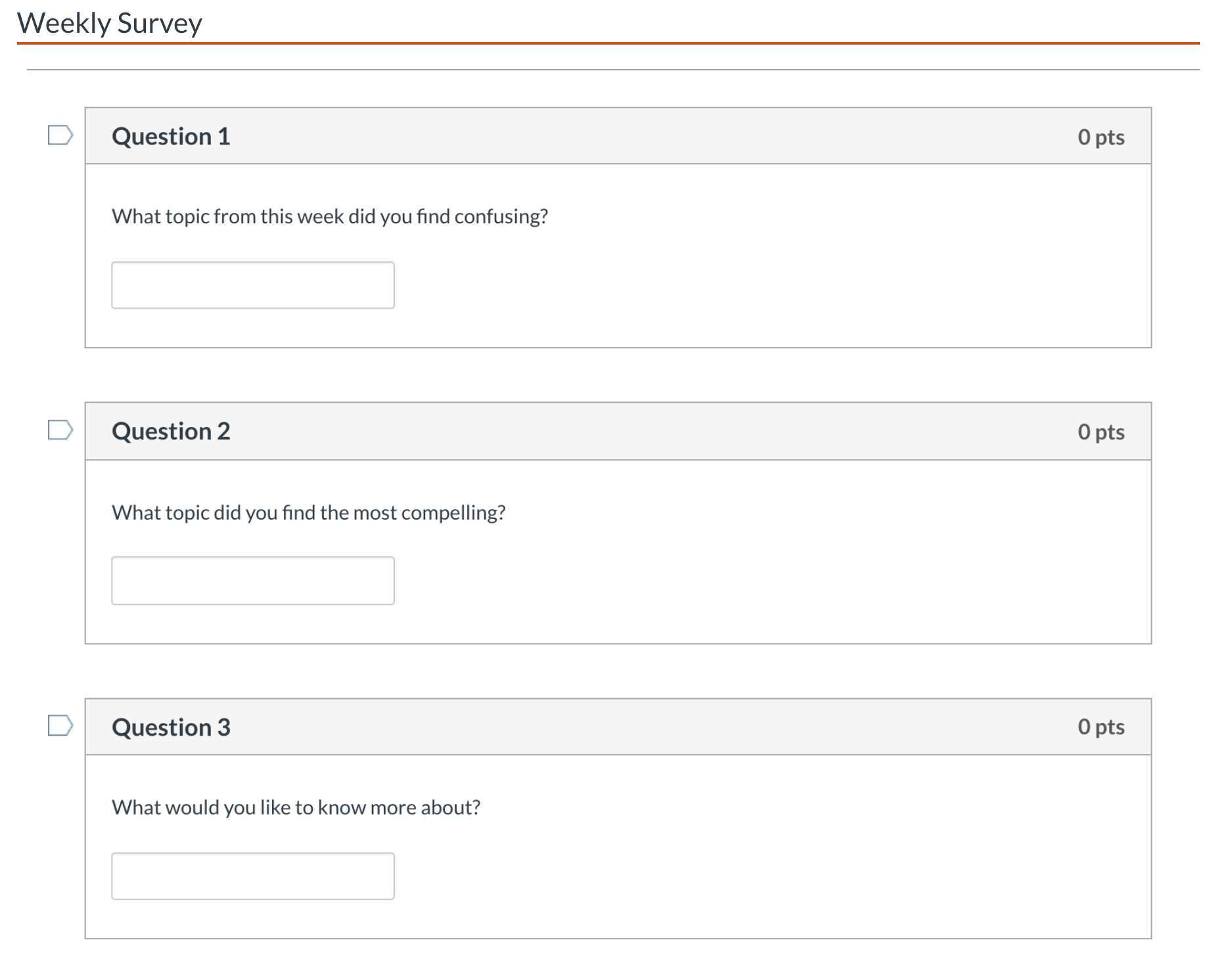
New online instructors often express concern about the loss of immediate student feedback they get by teaching in person. These educators count on in-class interaction to help shape their lesson plans in real-time. Student questions, lack of interaction, or even blank looks, help them understand what concepts are difficult for their learners. Others just feel more comfortable with the two-way nature of in-classroom communication. But teaching in an online environment doesn’t have to be mutually exclusive from gauging student interest and comprehension. Mud Cards I was first introduced to the concept of “Mud Cards” or “Muddiest Points” through an open course MIT offered in Active Learning in College-Level Science and Engineering Courses. The instructor described handing out index cards to … Adding a New Feedback Loop to Your Online Courses