
Inspire Blog Tag: instructional design

Intersectionality, Disability, and UDL

Introduction to Intersectionality In 1989, Kimberlé Williams Crenshaw, a lawyer and scholar of Critical Race Theory (CRT), coined the term intersectionality to describe the multiple and layered oppressions experienced by African American women. Over time, this term has been used to describe many aspects of social identity, particularly focusing on race, gender, and class oppression. Intersectionality allows us to consider the impact of multiple oppressions on individuals and groups. For example, asking what it means to be poor in the United States is different from asking what it means to be a poor, Black, woman in the United States, which is different from asking what it means to be a poor, Black, disabled woman in the Southern United States.  Intersectionality … Intersectionality, Disability, and UDL
Adding a New Feedback Loop to Your Online Courses

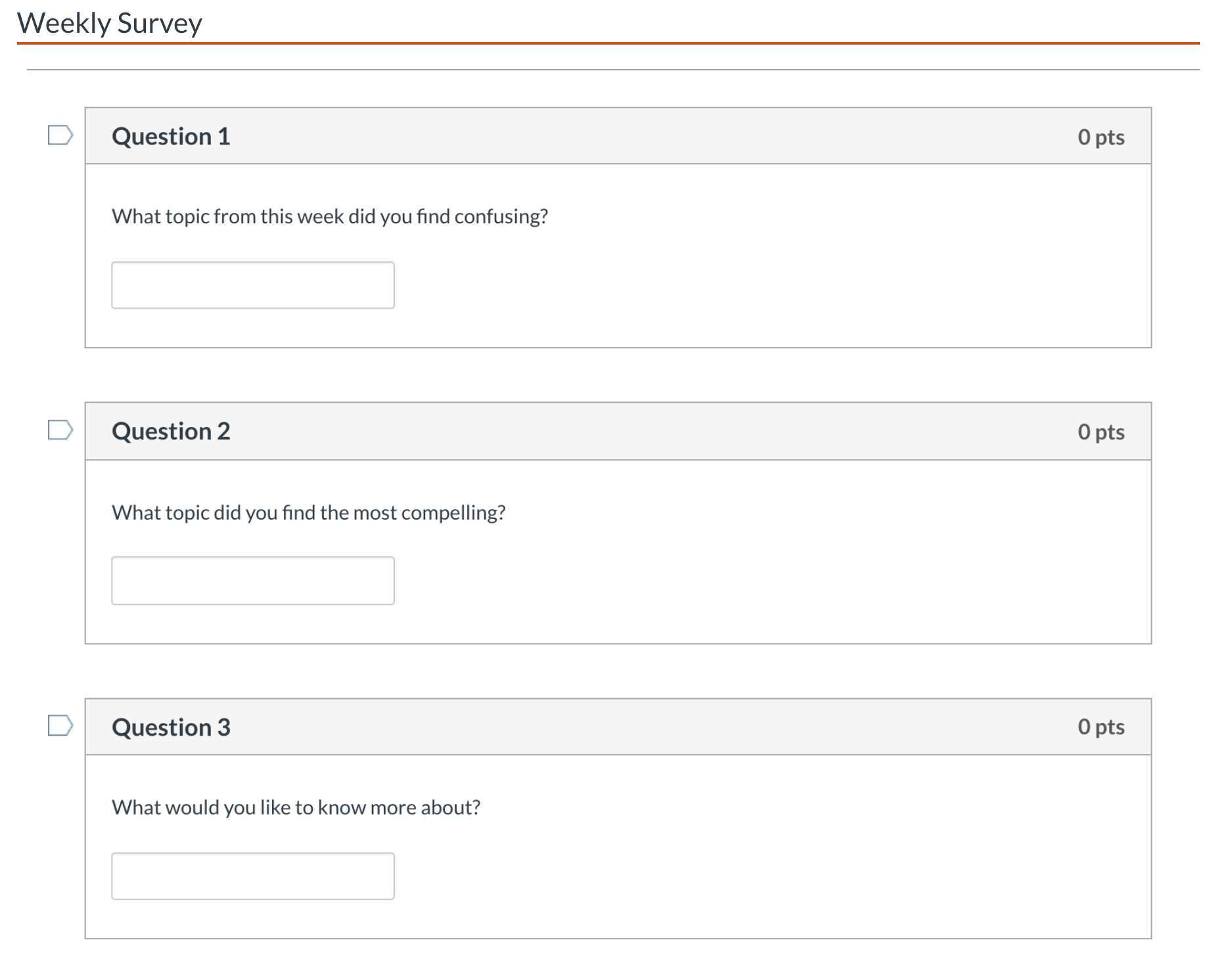
Canvas Survey with Mud Card Questions

New online instructors often express concern about the loss of immediate student feedback they get by teaching in person. These educators count on in-class interaction to help shape their lesson plans in real-time. Student questions, lack of interaction, or even blank looks, help them understand what concepts are difficult for their learners. Others just feel more comfortable with the two-way nature of in-classroom communication. But teaching in an online environment doesn’t have to be mutually exclusive from gauging student interest and comprehension. Mud Cards I was first introduced to the concept of “Mud Cards” or “Muddiest Points” through an open course MIT offered in Active Learning in College-Level Science and Engineering Courses. The instructor described handing out index cards to … Adding a New Feedback Loop to Your Online Courses

Flexibility and structure in course design: You don’t have to choose

Flexibility is an inclusive practice. Structure is an inclusive practice. Both of these statements are true–yet, many people might wonder how to reconcile these seemingly opposite approaches in their course designs. How does one build a course that is both flexible enough to accommodate the diverse needs of their students, yet structured in a way that is clear and unambiguous? In a practical sense, what do these words really mean? First, let’s define these terms and consider why each of these approaches are critical to student success. What do we mean by flexibility and structure and why are they both important features of course design and facilitation? Flexibility Flexibility is getting a lot of press right now, due to our … Flexibility and structure in course design: You don’t have to choose

Collaborative Online Annotation Tools for Engaging Students in Readings

Do you ever get the sense that students posting in their online discussions haven’t really engaged with the reading materials for that week? One way to encourage active engagement with course readings is to have students annotate directly in the article or textbook chapter that they are assigned. While it is common to see students annotating in their paper copies of their textbooks or readings, these aren’t easily shared with their peers or instructor. Of course, students could snap a photo of their handwritten annotations and upload that as a reading assignment task, though that does require additional steps on the part of both the student and instructor, and there is no interaction with others in the course during that … Collaborative Online Annotation Tools for Engaging Students in Readings

Open Pedagogy Part 1 – What is the value of going ‘open’?

Open Pedagogy Part 1 – What is the value of going ‘open’? By Ashlee M. C. Foster, Instructional Design Specialist Oregon State University Ecampus Are you committed to broadening access to education and knowledge, acknowledging and mitigating barriers, fostering social justice, and designing authentic and renewable learning experiences that contribute to the greater good? Do you employ pedagogical approaches that focus on student agency, collaboration, community, and connection to the public and world at large? If so, you may be an open educator at heart! This is a three-part blog which will introduce the potential value of open pedagogy (part 1), critically examine considerations and strategies for implementation (part 2), and explore current practitioner examples and design approaches (part 3), … Open Pedagogy Part 1 – What is the value of going ‘open’?