
Inspire Blog Tag: instructional design

Boosting Student Performance: The Impact of Well-crafted Quiz Instructions

I have always struggled with test anxiety. As a student, from first-grade spelling tests through timed essay questions while earning my Masters of Science in Education, I started exams feeling nauseous and underprepared. (My MSEd GPA was 4.0). I blame my parents. Both were college professors and had high expectations for my academic performance. I am in my 50s, and I still shutter remembering bringing home a low B on a history test in eighth grade. My father looked disappointed and told me, “Debbie, I only expect you to do the best you can do. But I do not think this is the best you can do.”  I am very glad my parents instilled in me a high value of … Boosting Student Performance: The Impact of Well-crafted Quiz Instructions
You Are Here: The Importance of Course Mapping

As higher-ed professionals involved in course design, we have the honor, privilege, and responsibility of shaping the learning experiences for countless students. Among the many tools at our disposal, course mapping stands out as a fundamental technique that deserves a spotlight. Couse mapping fosters clarity, and showcases alignment between the learning outcomes/objectives and course materials, assessments and activities. In this blog post, we will explore the importance of course mapping in online higher-ed courses, highlighting its role in meeting the new requirements in the recently updated Quality Matters (QM) rubric 7th edition. Join us as we delve into the transformative power of course mapping, benefiting course developers, instructors, instructional designers, and learners alike. The Big-Picture: The updated QM rubric (7th … You Are Here: The Importance of Course Mapping

Creating Effective Learning Environments: Lessons from UX Design

As educators and instructional designers, one of our tasks is to create online learning environments that students can comfortably use to complete their course activities effectively. These platforms need to be designed in such a way as to minimize extraneous cognitive load and maximize generative processing: that is, making sure that the learners’ efforts are spent on understanding and applying the instructional material and not on figuring out how to use the website or app. Research and practice in User Experience (UX) design – more specifically, usability – can give us insights that we can apply to improve our course page design and organization. Getting Started: General Recommendations Steve Krug, in his classic book Don’t Make Me Think: A Common … Creating Effective Learning Environments: Lessons from UX Design

Spring Cleaning for Your Courses:  Sometimes Less is More

How can we reclaim our online learning spaces and make them more inviting and functional? How can we help learners open all the proverbial doors and operate fully within the learning environment? You guessed it: While our first instinct might be to add more to the course, the answer might lie in the other direction.

Online Writing Support & Resources

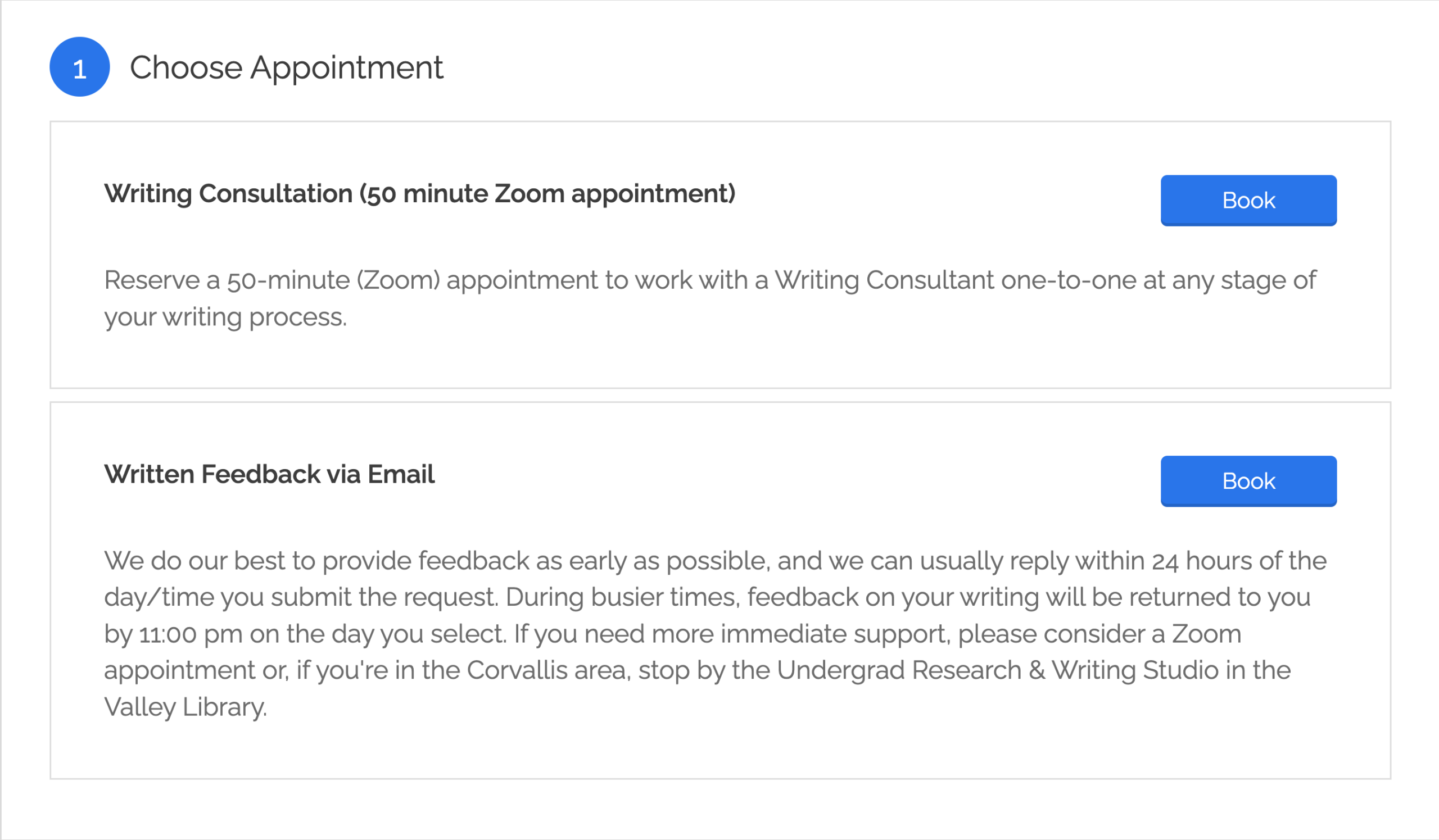
Online writing support center appointment options. 50 minute Zoom or written feedback via email

Ecampus students have access to a number of online resources to support their academic success at OSU. Receiving guidance and feedback on their writing assignments can be helpful across courses, throughout their planning and revision process. In this post, we will share more information about the current writing resources available to students, no matter where they are located, along with resources for faculty. OSU Writing Center The OSU Writing Center supports any type of writing project, during any stage of the writing process. Instructors can share this resource with students, or even integrate the writing center’s support as a step to receive guidance and feedback from a consultant in coordination with a class assignment. Online Writing Support (OWS) According to … Online Writing Support & Resources