
Inspire Blog Category: Tips & Tricks

Memory: Where All the Magic Happens

Memory plays the central role in learning – it is “the mechanism by which our teaching literally changes students’ minds and brains” (Miller, 2014, p. 88). Thus, understanding how memory works is important for both instructional designers and instructors. According to modern theories, memory involves three major processes: encoding (transforming information into memory representations), storage (the maintenance of these representations for a long time), and retrieval (the process of accessing the stored representations when we need them for some goal or task) (Miller, 2014). Let’s briefly review these processes and see how they may inform our course design and instruction. Encoding – What Is the Role of Attention and Working Memory? How does encoding happen? We receive information from our … Memory: Where All the Magic Happens
Learning from Games: Failure Edition

This is the paradox of failure in games. It can be stated like this: We generally avoid failure. We experience failure when playing games. We seek out games, although we will experience something that we normally avoid. (Juul, p. 2) As a continuation from my last blog post considering grades and Self-Determination Theory, I wanted to take a brief side-quest into considering what it means to experience failure. Jesper Juul’s The Art of Failure: An Essay on the Pain of Playing Video Games will provide the main outline and material for this post, while I add what lessons we might learn about feedback and course design in online settings. Dealing with Failure Juul outlines how games communicate through feedback using … Learning from Games: Failure Edition

Sound Ideas for Course Design

Audio is a term we all understand on some level. Commonly we think of audio as the transmission, reception, or reproduction of sound. Audible sound is what we hear. So, when we consider audio as an element of course design we are thinking about how sound can be used to communicate or support learning in an online course environment. Integrating audio in course delivery can be quite powerful if done well. Perhaps the most common method of using sound in an asynchronous online course is via narrated lecture. The narrated lecture is typically a voice over a slide presentation or screencast. It can be an essential tool of instruction if designed effectively. Another way the voice of an instructor can … Sound Ideas for Course Design

Adding a New Feedback Loop to Your Online Courses

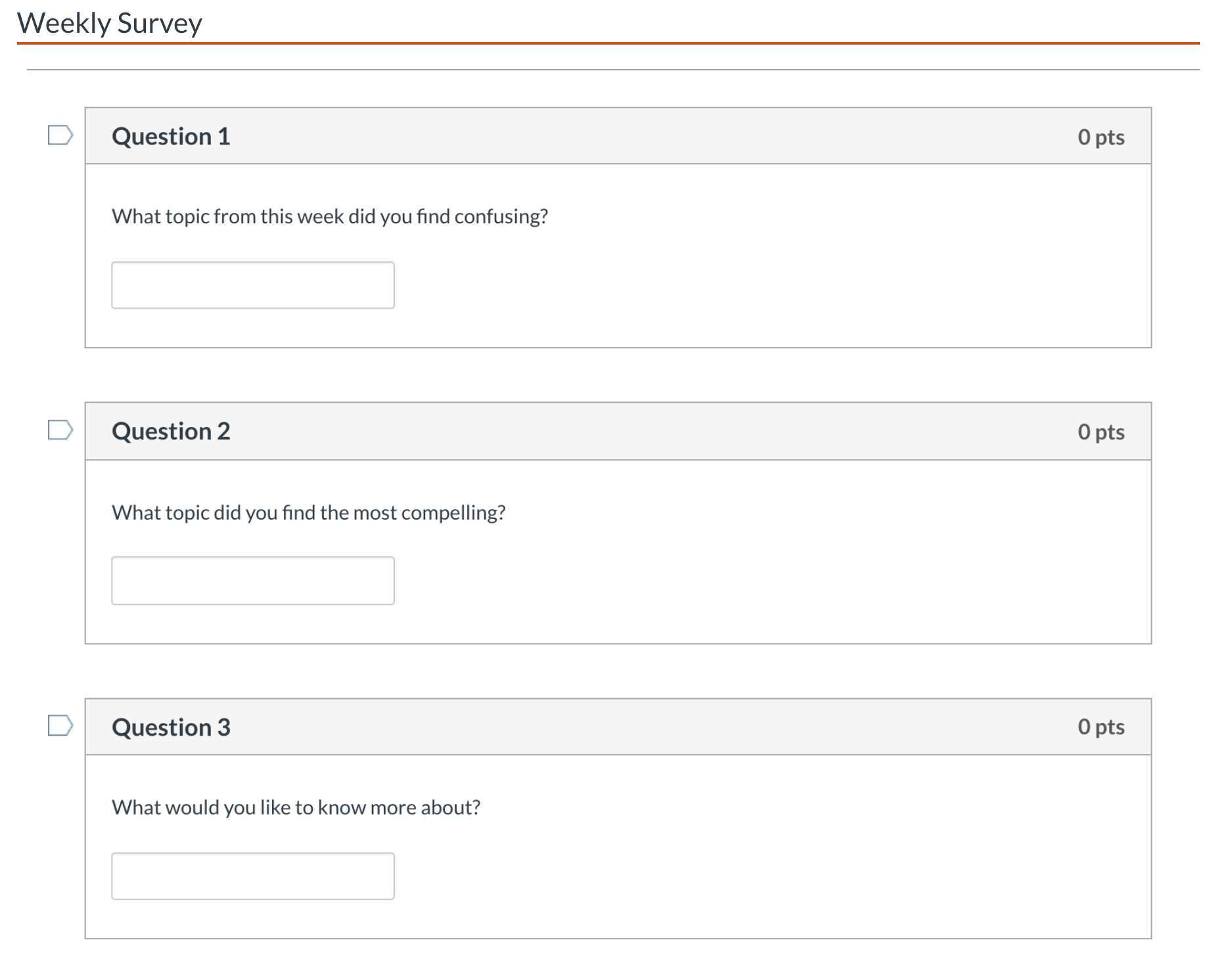
Canvas Survey with Mud Card Questions

New online instructors often express concern about the loss of immediate student feedback they get by teaching in person. These educators count on in-class interaction to help shape their lesson plans in real-time. Student questions, lack of interaction, or even blank looks, help them understand what concepts are difficult for their learners. Others just feel more comfortable with the two-way nature of in-classroom communication. But teaching in an online environment doesn’t have to be mutually exclusive from gauging student interest and comprehension. Mud Cards I was first introduced to the concept of “Mud Cards” or “Muddiest Points” through an open course MIT offered in Active Learning in College-Level Science and Engineering Courses. The instructor described handing out index cards to … Adding a New Feedback Loop to Your Online Courses

Managing the Pace & Workload

Lately I’ve heard from a number of faculty whose students have expressed stress or overwhelm at the workload in a course. Further, students as well as faculty have had to adjust to a new routine or pace in their lives in recent months. All of this change gives us a chance to examine the workload and pace of a course so that it is manageable for both students and instructors. To that end, I offer three simple things that faculty can do to make their workload more manageable: Manage expectations Post time estimates for each activity Consider your own availability Manage expectations One of the most effective ways to help students understand how much they should plan to do each … Managing the Pace & Workload