
Inspire Blog

Problem Solving, Team Conflict and Large Enrollment in Online Courses: Research and Design

Core Education at Oregon State University launched summer 2025 and is designed to deepen how students think about problem-solving in ways that transcend disciplinary-specific approaches. It aims at preparing students to be adaptive, proactive members of society who are ready to take on any challenge, solve any problem, advance in their chosen career and help build a better world (Oregon State University Core Education, 2025). Designing Seeking Solutions Signature Core category courses presents a few challenges, such as the nature of wicked problems, cross-discipline teamwork, and the global impact of wicked problems, to name just a few. In the past eight months, instructional designers at Oregon State University Ecampus have worked intensively to identify design challenges, brainstorm course design approaches, … Problem Solving, Team Conflict and Large Enrollment in Online Courses: Research and Design
Student Voices Support Quality Standards in Online Education

This post was written in collaboration with Mary Ellen Dello Stritto, Director of Ecampus Research Unit. Quality Matters standards are supported by extensive research on effective learning. Oregon State University’s own Ecampus Essentials build upon these standards, incorporating OSU-specific quality criteria for ongoing course development. But what do students themselves think about the elements that constitute a well-designed online course? The Study The Ecampus Research Unit took part in a national research study with Penn State and Boise State universities that sought student insight into what elements of design and course management contribute to quality in an online course. Data was collected from 6 universities across the US including Oregon State in Fall of 2024. Students who chose to participate … Student Voices Support Quality Standards in Online Education

Meet Agentic AI: Implications for Academic and Learning Integrity

Over the past few years, Higher Education (HE) has been called to action in response to the rise of Generative Artificial Intelligence (GenAI) tools. As Artificial Intelligence (AI) becomes more autonomous and capable, proactive steps are needed to preserve academic and learning integrity. This article will explore tangible strategies educators can apply to their unique program and course contexts. Only slight adjustments may be necessary to support learning processes and capture evidence of learning, as changes will build upon the excellent work that is already occurring. Initially, the focus in HE was on understanding the potential impact these tools would have on teaching and learning. Awareness of GenAI capabilities, limitations, and risks has been acknowledged with great care. Today, the … Meet Agentic AI: Implications for Academic and Learning Integrity

Liminal Space: Belonging and UDL 3.0

This is a guest post by Winter 2025 Ecampus Instructional Design Intern Terrence Scott. Creating Online Learning Spaces Where Adult Learners Belong Today’s college students are increasingly adults returning to education to pursue career shifts, personal growth, or new credentials. Yet, this return often brings discomfort. Adult learners find themselves in a liminal space, caught between who they were and who they are becoming as students. This “in-between” state is a psychological and social threshold where identity and belonging are in flux (Maksimović, 2023; Turner, 1969). Liminal space is defined as “characterized by the questioning and reexamination of one’s identity, often as a result of transitional moments in an individual’s life such as separation, loss, and conflicts” (Maksimović, 2023). Rather … Liminal Space: Belonging and UDL 3.0

Improving the Feedback Cycle, Part 2

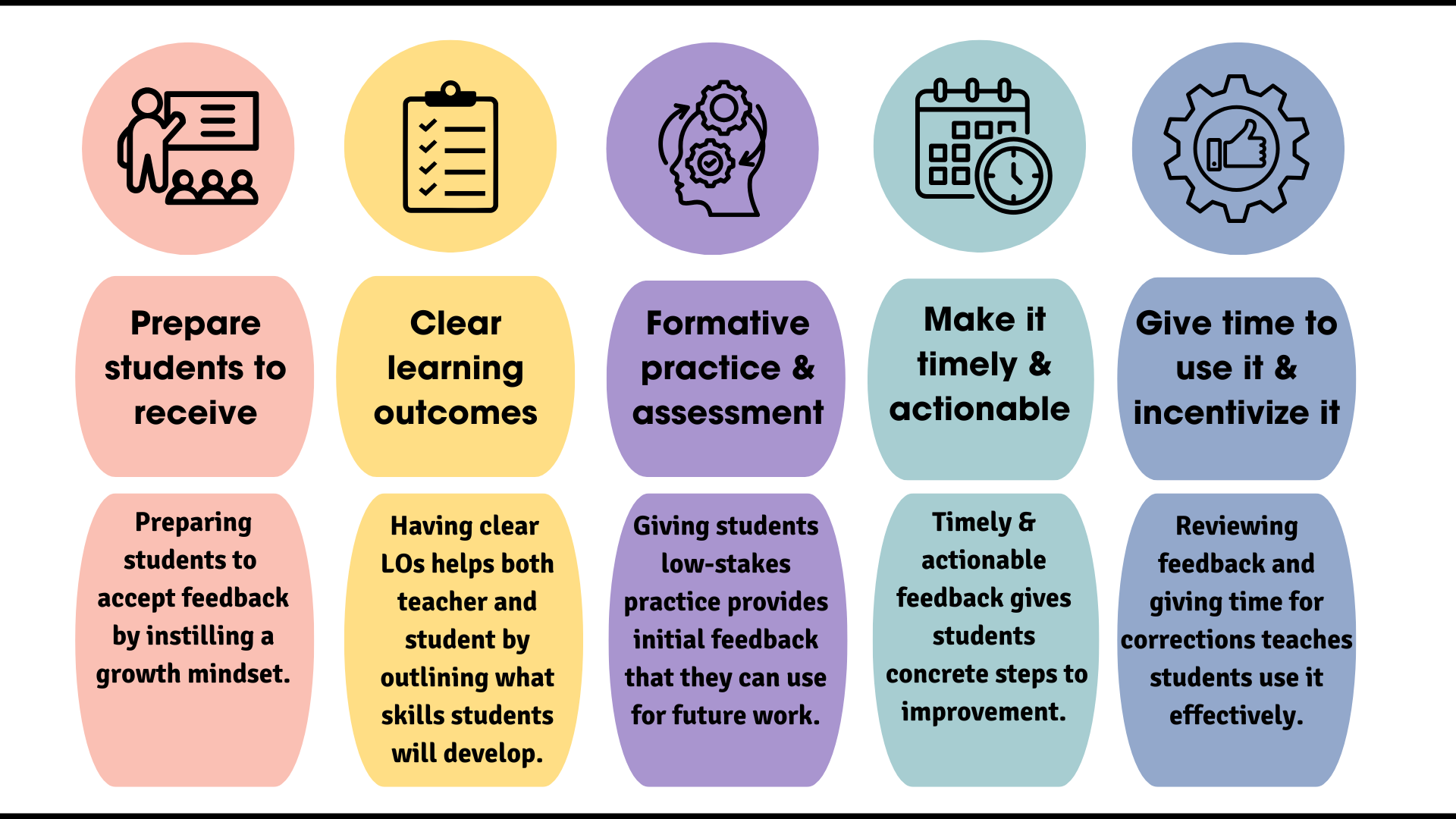
chart describing the steps in the feedback process

In part one of this two-part blog series, we focused on setting the stage for a better feedback cycle by preparing students to receive feedback. In part two, we’ll discuss the remaining steps of the cycle- how to deliver feedback effectively and ensure students use it to improve. In part one, we learned about the benefits of adding a preliminary step to your feedback system by preparing students to receive suggestions and view them as helpful and valuable rather than as criticism. If you haven’t read part one, I recommend doing so before continuing. This first crucial but often overlooked step involves fostering a growth mindset and creating an environment where students understand the value of feedback and learn to … Improving the Feedback Cycle, Part 2