
Inspire Blog Tag: ecampus

Academic Honesty in Online Assessment

There are two sides to the story of security of online assessments. On the one side, cheating does exist in online assessments. Examity’s president Michael London summarized five common ways students cheat on online exams: The old-school try of notes; The screenshot; The water break; The cover-up; and The big listen through devices such as Bluetooth headset (London, 2017). Newton (2015) even reported the disturbing fact that “cheating in online classes is now big business”. On the other side, academic dishonesty is a problem of long history, both on college campuses and in online courses. The rate of students who admit to cheating at least once in their college careers has held steady at somewhere around 75 percent since the … Academic Honesty in Online Assessment
Audio feedback: What does the research say?

First, let’s start by considering the characteristics of effective feedback in general. What comes to mind? Perhaps you hear in your head (in the authentically authoritative voice of a past professor) the words timely, frequent, regular, balanced, specific. Perhaps you recall the feedback sandwich–corrective feedback sandwiched between positive feedback. Perhaps you consider rubrics or ample formative feedback to be critical components of effective feedback. You wouldn’t be wrong. As educators, we understand the main characteristics of effective feedback. But despite this fact, students are often disappointed by the feedback they receive and faculty find the feedback process time consuming, often wondering if the time commitment is worth it. As an instructional designer, I hear from faculty who struggle to get … Audio feedback: What does the research say?

Blended Learning: What Do the Faculty Say? – Part 1

Oregon State University now has over 500 hybrid (“blended”) courses including the Ecampus hybrid degree and certificate programs offered through the new Portland Center. What do OSU faculty say about blended learning? Since 2012, participants in the Hybrid Faculty Learning Community have been blogging about their approaches to blended course design and teaching. The resulting 200+ posts in the Hybrid Faculty Blog are a rich compendium of reflections on hybrid teaching and learning. As they design hybrid courses, faculty from across OSU describe how they come to terms with a course format that has great potential to successfully engage today’s students, but that can be challenging to do well, especially the first time. Instructors celebrate the possibilities of a course … Blended Learning: What Do the Faculty Say? – Part 1

Lecture Videos: Short & Sweet

When teaching face-to-face, you might break your lectures into weeks because you will only meet with students once or twice a week.  You hope to give them all the information they need during your face-to-face sessions for them to successfully complete work independently between classes. While a typical face-to-face lecture can span 50-90 minutes, there is evidence to suggest shortening the length for your online students may be a better practice.  Your online students may be in and out of your course many more times than they would be face-to-face and this gives you the opportunity to think about designing your video lectures differently.  Organizing your lectures topically, rather than weekly can be a powerful way to redesign your course. … Lecture Videos: Short & Sweet

Asynchronous Conversations in VoiceThread

student response slide

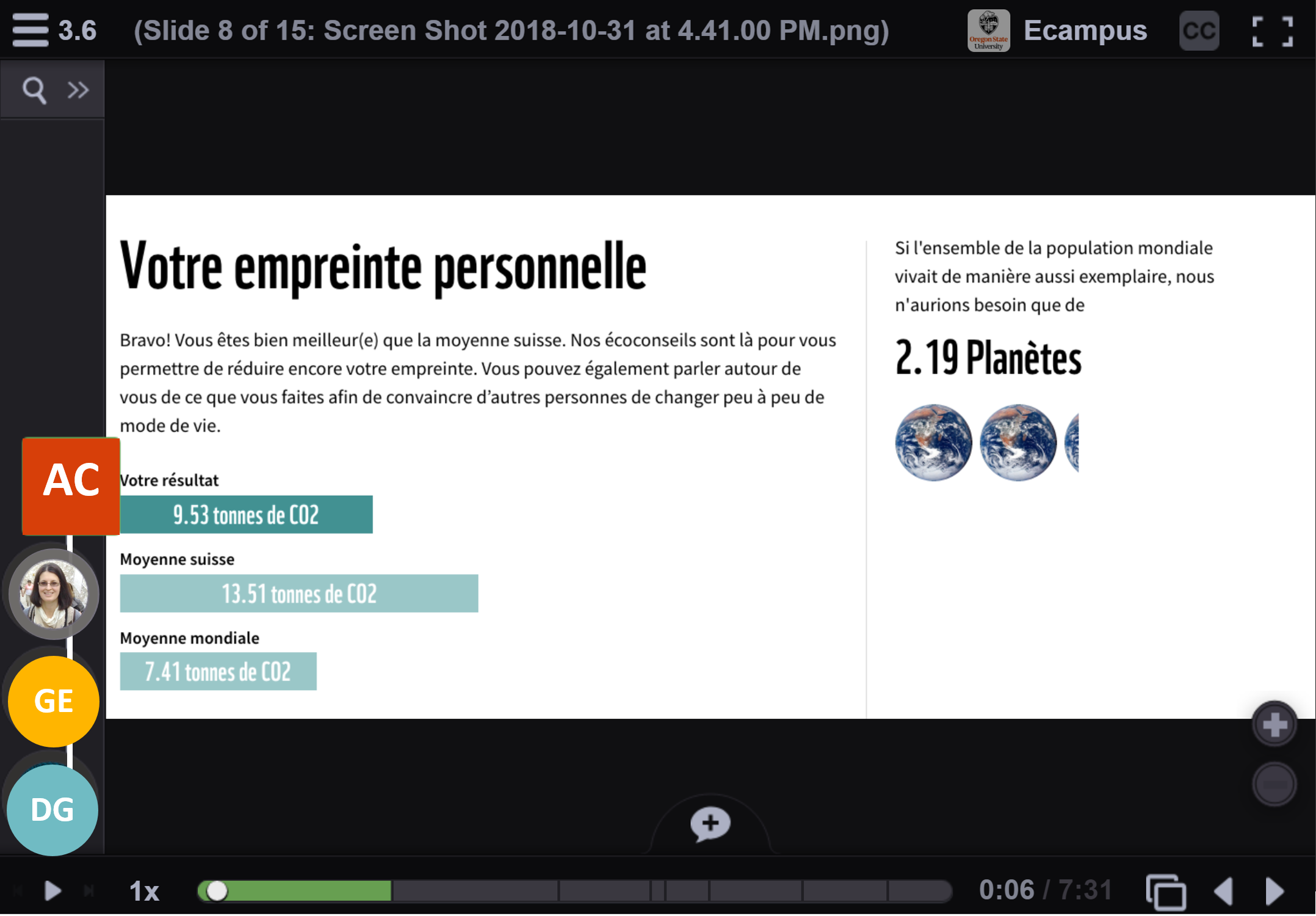
In my last post, I described how Ecampus courses use synchronous study sessions to provide listening and speaking practice to students of world languages. Much of the Ecampus language learning experience is entirely asynchronous, however, to provide flexibility for our students. So how exactly do students converse asynchronously? This post will describe the design of asynchronous listening and speaking exercises in 300-level French conversation courses, executed by Ana-Maria M’Enesti, PhD, and facilitated via VoiceThread, a slide show within the LMS that displays course content about which participants comment via text, audio, or video. VoiceThread was an appealing platform because of the ease with which students can add audio or video comments, more streamlined than the protocol for uploading video to … Asynchronous Conversations in VoiceThread