
Inspire Blog Tag: Instructor

Customizing Your Canvas Course

Customizing your Canvas course is a simple way to create a smoother, more intuitive learning experience—for both you and your students. With a few strategic adjustments, you can create a polished, efficient Canvas set-up that gives students a clean, streamlined learning environment. Personalize Your Home Page Instructors can choose which page students see first when clicking into their Canvas course, and a well-designed homepage can act as a dashboard for the entire course. Most Ecampus courses have a home page that includes a custom banner with the course code and name as well as links to the modules, Start Here module, and Syllabus page. You might want to add links to external tools or websites your students will use frequently … Customizing Your Canvas Course
Haunted by a Blank Course: Tales from a First-Time Developer

Special Edition: Guest Blog by Assistant Professor of Practice (Urban Forestry), Jennifer Killian When I was asked to create a new course for Oregon State University’s Ecampus program, my first reaction was a mix of sheer excitement… and, well, a little terror. I’ve built workshops, presentations, and even all-day trainings, but assembling ten weeks of graduate-level content from scratch? That felt like wandering through a haunted house to me. Dark, empty, and full of unknowns. Adding to the surrealness, I realized that thirteen years ago, I was a graduate student here, taking several Ecampus courses myself including an early version of the very class I would now be teaching. The idea that I could bring my professional experience back to … Haunted by a Blank Course: Tales from a First-Time Developer

Improving the Feedback Cycle, Part 2

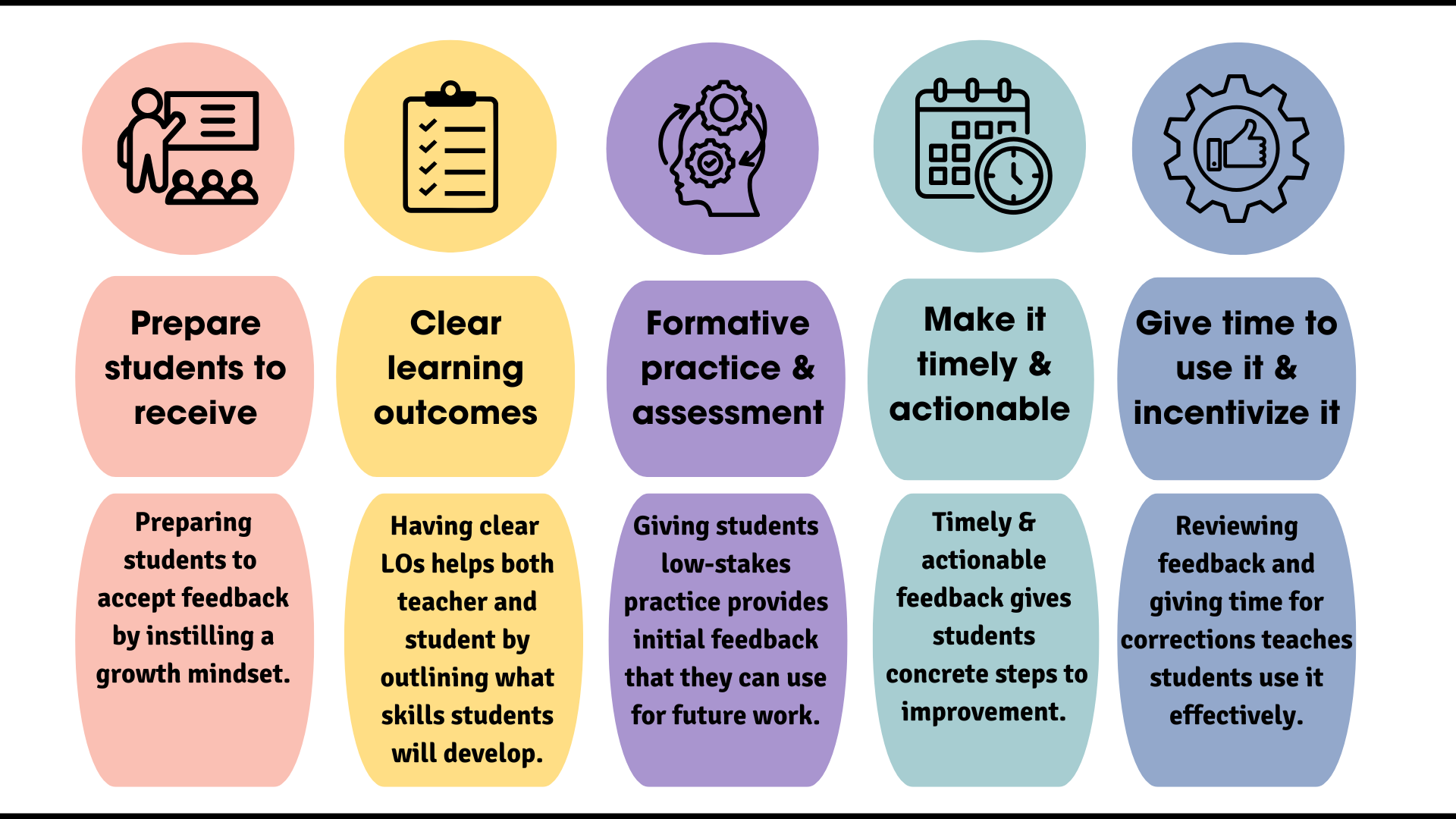
chart describing the steps in the feedback process

In part one of this two-part blog series, we focused on setting the stage for a better feedback cycle by preparing students to receive feedback. In part two, we’ll discuss the remaining steps of the cycle- how to deliver feedback effectively and ensure students use it to improve. In part one, we learned about the benefits of adding a preliminary step to your feedback system by preparing students to receive suggestions and view them as helpful and valuable rather than as criticism. If you haven’t read part one, I recommend doing so before continuing. This first crucial but often overlooked step involves fostering a growth mindset and creating an environment where students understand the value of feedback and learn to … Improving the Feedback Cycle, Part 2

Welcoming Online Students

One of my favorite design strategies is to make a small adjustment that delivers a big impact. When it comes to creating a welcoming online course, certain small adjustments can do just that and go a long way in warming up the online classroom. But first, let us look at why online courses ought to be welcoming and then what it means to be welcoming in the online space. Why Welcoming Students Is Important First, why is it important to design a welcoming course? According to the OSU Ecampus Online Teaching Principles, which are supported by research and endorsed by Quality Matters, it is recommended to “[m]ake facilitation choices that support diverse students and make each student feel welcomed and … Welcoming Online Students

Enhancing Course Quality

This layered paper art depicts the Heceta Head Lighthouse amid colorful hills, a flowing river, and tall green trees. Whimsical clouds and birds add depth, creating a vibrant and detailed handcrafted scene.

I’d like to share a recent experience highlighting the crucial role of collecting and using feedback to enhance our online course materials. As faculty course developers and instructional designers, we understand the importance of well-designed courses. However, even minor errors can diminish the quality of an otherwise outstanding online course. A Student’s Perspective Recently, feedback was forwarded to me submitted by an online student enrolled in a course I had helped develop. He praised the overall design of the courses and the instructors’ responsiveness, but he pointed out some typographic and grammatical errors that caused confusion. He mentioned issues like quiz answers not matching the questions and contradictory examples. What stood out to me was his statement: “These courses are … Enhancing Course Quality