Inspire Blog Tag: teaching

Five Ways Faculty Can Support Online Student Mental Health

In May 2026, OSU became the first Health Promoting University in Oregon, officially adopting The Okanagan Charter, an international, collaboratively drafted vision that calls on institutions of higher education to incorporate health-promoting practices at every level and create supportive environments that encourage and inform health knowledge across campus. As part of this effort, over the past two years Oregon State University’s Student Mental Health Improvement Initiative has worked to gather information about student mental health across the Corvallis campus, OSU-Cascades, and Ecampus. Sponsored by the Health Promoting University Core Group, Counseling & Psychological Services (CAPS), and the Center for Teaching and Learning (CTL), the initiative brought together faculty, staff, and campus partners to examine how institutional practices influence student well-being. … Five Ways Faculty Can Support Online Student Mental Health

Whose Work Is It Anyway? Writing an AI Statement Worth Reading

Last year, as the instructional designer for a software engineering course, I knew the instructor had leaned on AI throughout the course’s development. I suggested he be transparent about it with his students. After all, he was asking the same of them. What he wrote back went further than I expected. His syllabus statement opens not with rules for students but with an accounting of his own use. He names Claude the second author of his course, separates his own contribution from what emerged from that collaboration, and only then turns to what students may do. After getting his permission, I shared it with my team. Within minutes, colleagues were asking to keep it as an example. One had just … Whose Work Is It Anyway? Writing an AI Statement Worth Reading

Exploring Resilient Teaching

The concept of resilient teaching has come to the forefront in the 2-plus years since the COVID-19 pandemic suddenly and radically altered the landscape of higher education. As faculty, students, and administrators devise strategies to cope with the myriad changes brought about by the pandemic, questions are ubiquitous about how to best support students and colleagues; how to adapt to changes in perceptions, practices, and expectations regarding teaching and learning; and how to avoid burnout. Definitions and Scope What is resilience? Resilience, in the physical sciences, refers to “the capability of a strained body to recover its size and shape after deformation caused especially by compressive stress.” Resilience, in a psychological sense, is “the process and outcome of successfully adapting … Exploring Resilient Teaching

Improving Group Work in Asynchronous Courses

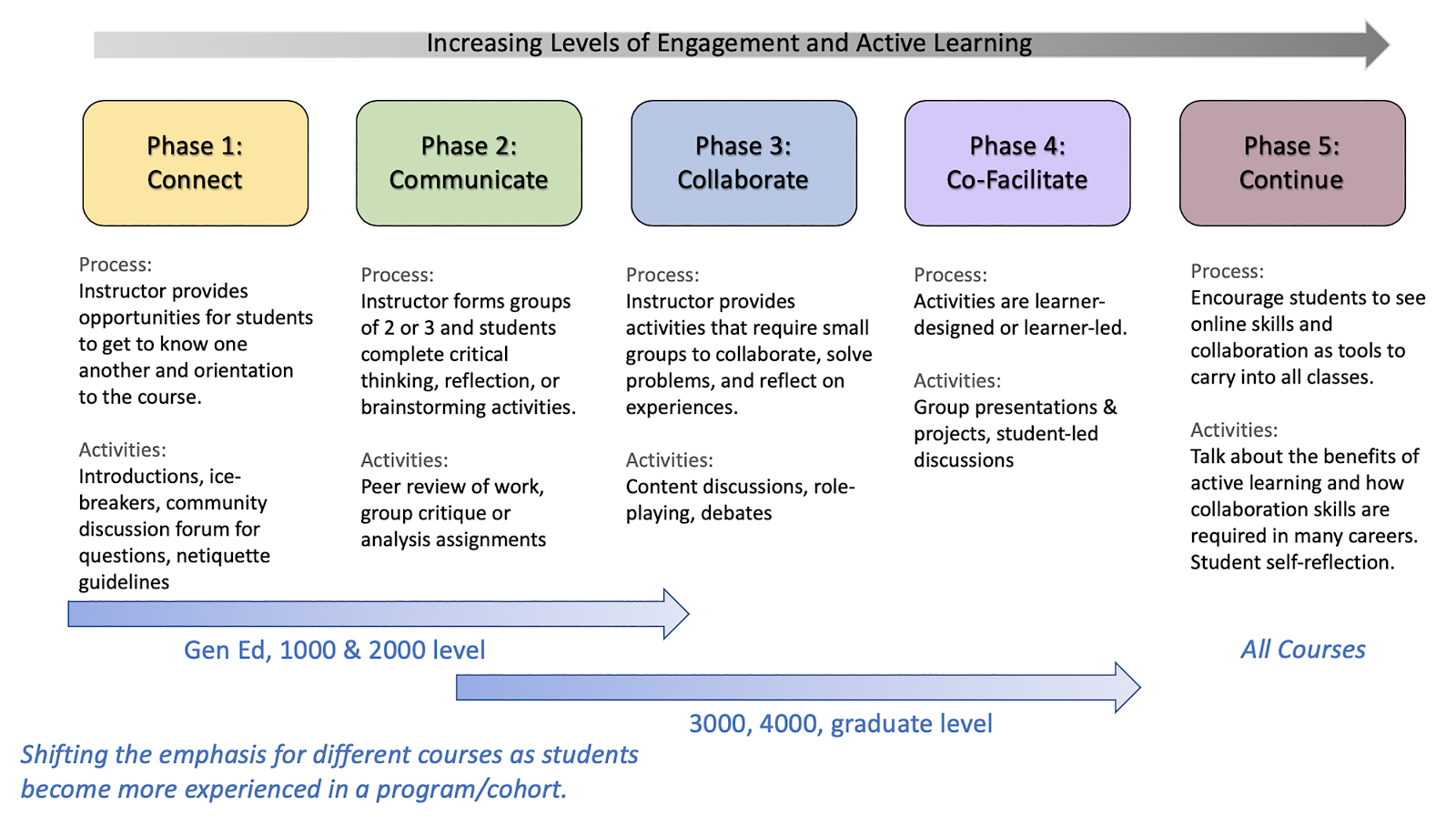
chart of five phases of engagement: connect, communicate, collaborate, co-facilitate, and continue

 Why Group Work Is Important  Love it or hate it, group work is an important part of education. Learning to work cooperatively with diverse people is a core 21st century skill, one which employers increasingly value and expect new workers to have mastered. Experience gathered from group work in educational settings directly transfers to and prepares students for successful collaboration in work teams. By collaborating in teams, students learn a wide range of discrete as well as soft skills that make group work worth the effort, including those below. Technology skills Social skills Self-awareness Empathy Coping with stress Creating work plans and schedules Forecasting needs and hurdles Time management & meeting deadlines Working with difficult personalities Managing & navigating unmet … Improving Group Work in Asynchronous Courses

Memory: Where All the Magic Happens

Memory plays the central role in learning – it is “the mechanism by which our teaching literally changes students’ minds and brains” (Miller, 2014, p. 88). Thus, understanding how memory works is important for both instructional designers and instructors. According to modern theories, memory involves three major processes: encoding (transforming information into memory representations), storage (the maintenance of these representations for a long time), and retrieval (the process of accessing the stored representations when we need them for some goal or task) (Miller, 2014). Let’s briefly review these processes and see how they may inform our course design and instruction. Encoding – What Is the Role of Attention and Working Memory? How does encoding happen? We receive information from our … Memory: Where All the Magic Happens