
Inspire Blog Category: Assignments

Term Project – Doesn’t Have to Be an Odyssey  
One instructor I work with said this recently: I like that idea! So then students can start their project early on, get some classmates’ comments, and submit their final version” This response came after we spent some time discussing the challenge that comes with a term project that gets submitted as a one-time assignment at the end of the term. Some instructors express interest and concerns about developing a term project and how to implement it in an asynchronous course. A project can be a great opportunity for engaging students with the content, learning from and with peers, and applying the concepts they learn in more practical and hands-on activities; and for it to be clear and well-implemented, it needs structure. However, it is not always clear for some instructors how the project could be spread out through the term in ways that allow students to Term Project – Doesn’t Have to Be an Odyssey  

Discussion Boards: Should They Stay, Go, or Revamp in the AI Era?

“Discussions are boring”, “it is so hard for students to truly engage,” “the linearity of the discussions doesn’t help to navigate and find the threads”, “posts could be AI-generated.” If you’ve voiced one of these about discussion boards, you’re not alone. Oftentimes, I hear instructors express these concerns. Discussion boards were once considered spaces for bringing students together to engage in authentic and genuine conversations. However, in today’s AI world, the concerns are compounded by the risk that discussion posts could be generated by AI, lacking students’ own voices and personal investment in building community. What is not working with discussion boards? Discussion boards have been the default tool in online courses to create a space for students and their instructors Discussion Boards: Should They Stay, Go, or Revamp in the AI Era?

The Group Project Paradox: Everyone Thinks They Did the Most Work

The Skill Students Resist, and Employers Expect I have a confession. When I was earning my M.S.Ed. online, I dreaded seeing “group project” on a syllabus. I juggled coursework with a full-time job, logged in at odd hours, and did most of the work on every collaborative assignment. My standards were higher, my contributions more substantial, my late nights longer. I carried the team. Here’s the awkward part: so did everyone else. Researchers have been studying this phenomenon since 1979, when psychologists Michael Ross and Fiore Sicoly found that group members consistently overestimate their own contributions (Ross & Sicoly, 1979). When you ask everyone on a team to estimate their percentage of the work, the numbers don’t add up to The Group Project Paradox: Everyone Thinks They Did the Most Work

Refining Rubrics & Assessments: AI as Design Support – Part 2

This blog post is a continuation from “Refining Rubrics & Assessments: AI as Design Support – Part 1“. Using AI to Refine Rubric Language In the previous post, I gave an assignment prompt to Copilot (as that’s the recommended tool at Oregon State University) and asked it to complete the task. For reference, here is the task. Rubrics are often the weakest link in assessment design, particularly when descriptors rely on vague phrases like “meets expectations” or “demonstrates understanding.” One way to evaluate rubric clarity is to ask AI to self-assess its own response using the rubric criteria. If the model can plausibly justify a high score despite shallow reasoning or inconsistent logic, the rubric may not be clearly distinguishing Refining Rubrics & Assessments: AI as Design Support – Part 2

Refining Rubrics & Assessments: AI as Design Support – Part 1

For centuries, knowledge and access to education was restricted to just a few. In today’s’ world, almost anybody can access information through the web and more recently through AI tools. However, it is important to recognize that these tools, while offering expansive access to content of varied nature, also pose challenges. Generative AI has fundamentally changed how students interact with assignments, but it has also given instructors a powerful new lens for examining their own assessment design. Rather than treating AI solely as a threat to academic integrity, we can use it as a diagnostic tool – one that quickly reveals whether our assignments and rubrics are actually measuring what we think they are. If an AI can complete an Refining Rubrics & Assessments: AI as Design Support – Part 1

Student Voices Support Quality Standards in Online Education

This post was written in collaboration with Mary Ellen Dello Stritto, Director of Ecampus Research Unit. Quality Matters standards are supported by extensive research on effective learning. Oregon State University’s own Ecampus Essentials build upon these standards, incorporating OSU-specific quality criteria for ongoing course development. But what do students themselves think about the elements that constitute a well-designed online course? The Study The Ecampus Research Unit took part in a national research study with Penn State and Boise State universities that sought student insight into what elements of design and course management contribute to quality in an online course. Data was collected from 6 universities across the US including Oregon State in Fall of 2024. Students who chose to participate Student Voices Support Quality Standards in Online Education

Improving the Feedback Cycle, Part 1

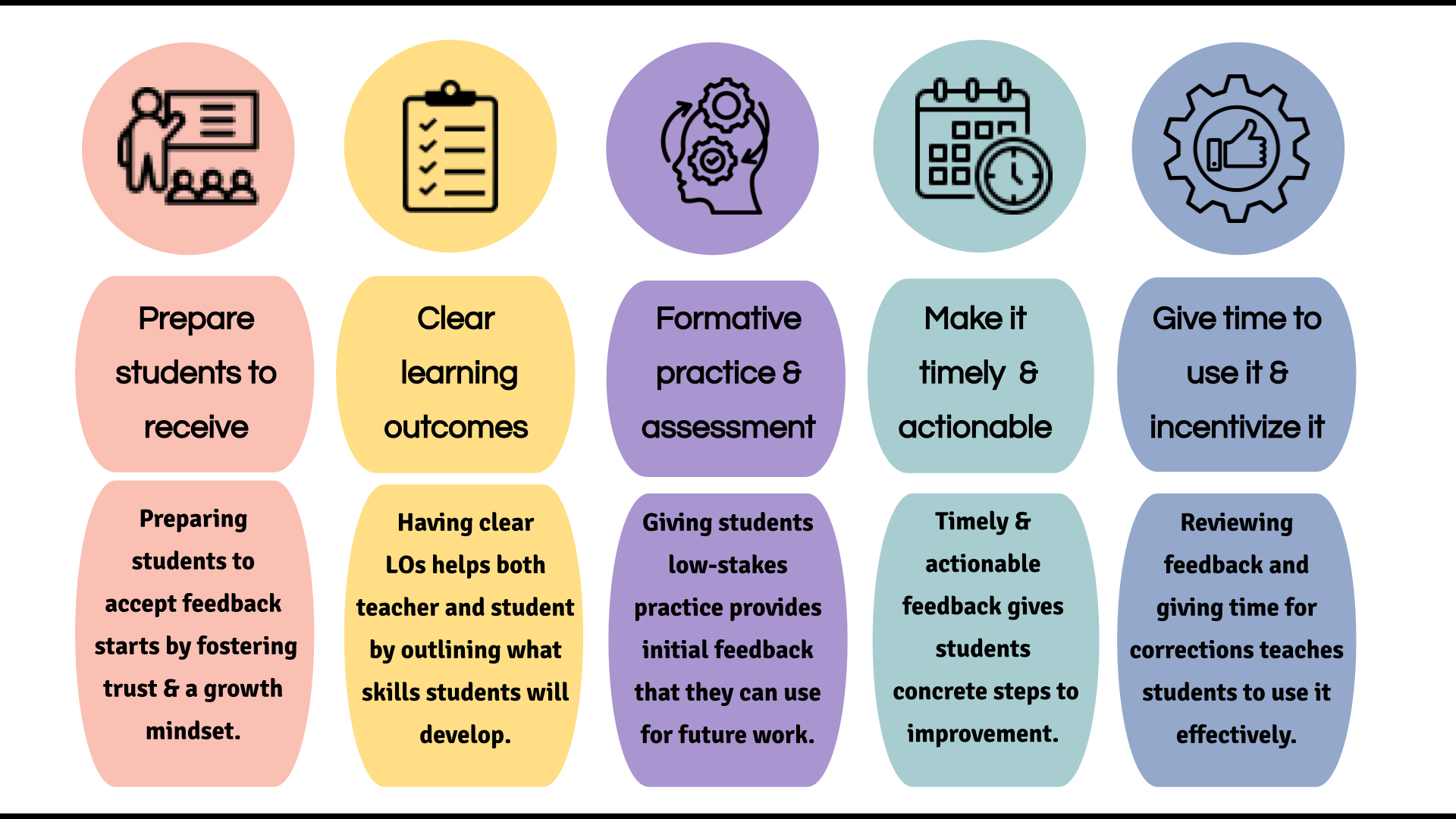
graphic image of the five steps in the feedback cycle

An effective feedback cycle starts before the feedback is given by laying careful groundwork. The first and often-overlooked step in the cycle is preparing students to receive feedback, which takes planned, ongoing work.

The Other AI – Fostering Academic Integrity in Online Courses

This image is part of the Transformation Projects at the Ars Electronica Kepler's Garden at the JUK. The installation AI Truth Machine deals with the chances and challenges of finding truth through a machine.

All the buzz recently has been about Generative AI, and for good reason. These new tools are reshaping the way we learn and work. Within the many conversations about Artificial Intelligence in Higher Ed a common thread has been appearing regarding the other AI–Academic Integrity. Creating and maintaining academic integrity in online courses is a crucial part of quality online education. It ensures that learners are held to ethical standards and encourages a fair, honest, and respectful learning environment. Here are some strategies to promote academic integrity and foster a culture of ethical behavior throughout your online courses, even in the age of generative AI. Create an Academic Integrity Plan Having a clear academic integrity plan is essential for any The Other AI – Fostering Academic Integrity in Online Courses

Assessment Design: The Case Against Extra Credit

As a follow-up to discussing equity in grading and group work, Feldman (2019) offers a compelling case against the use of extra credit. “But wait a minute,” I can hear you saying, “Extra credit is optional—students have to opt-in if they want to do it! And it can be fun! What’s wrong with that?” Many instructors may think of extra credit as a way to benefit students and give them extra opportunities in a course, especially at the end of a term, to improve their grade, take on additional challenges, and demonstrate additional skills they have learned. (I know I thought about extra credit that way at one time!) However, there is more at play with extra credit than you Assessment Design: The Case Against Extra Credit

Spring Cleaning for Your Courses:  Sometimes Less is More

How can we reclaim our online learning spaces and make them more inviting and functional? How can we help learners open all the proverbial doors and operate fully within the learning environment? You guessed it: While our first instinct might be to add more to the course, the answer might lie in the other direction.