
Inspire Blog Category: Resources, Tools & Trends

Inclusive Teaching Online: A Shared Responsibility

“Educators and learning designers must seek to resolve societal shortcomings, including the inequity of education and opportunity; the lack of social justice; policy issues and their implications; implicit bias in terms of race or ability; as well as layers of equity and inclusion. Building community and bridging divides are goals for all education.” Toward Inclusive Learning Design: Social Justice, Equity, and Community. AECT Research Symposium 2021. This was the underlying premise of a research symposium on learning design in which I participated in the summer of 2021. While this premise emphasizes our responsibility for designing learning experiences that are not only inclusive but just, there is an implicit idea that design alone is not a sufficient condition for inclusivity; we … Inclusive Teaching Online: A Shared Responsibility
Course Design Challenge: Try Subtraction

In your work as an instructor or instructional designer, what kinds of course design problems have you been trying to solve lately? Perhaps there’s a discussion board assignment that you’d like to make more engaging, or maybe there’s a lab activity that students struggle with. According to recent research findings published in the journal Nature, “…people are more likely to consider solutions that add features than solutions that remove them, even when removing features is more efficient” (Meyvis, T. and Yoon, H., 2021). In a course design context, this means we will probably reach for something we can add to our course to fix a problem: a shiny new tool we learned about at a conference, an extra video lecture, … Course Design Challenge: Try Subtraction

My Experience with Emojis in Online Courses: Affordances and Considerations

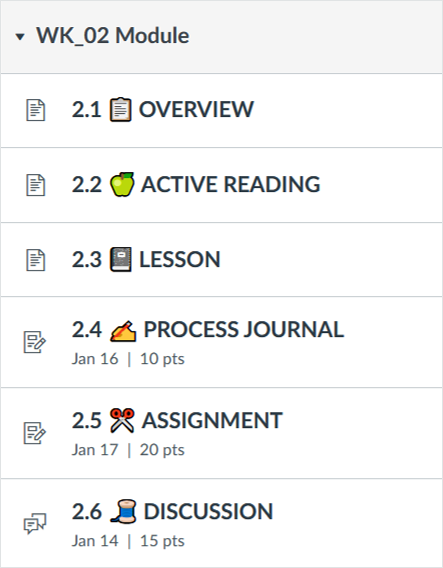
clipboard, green apple, notebook, hand writing with pencil, scissors and spool of thread emojis used in module items

What should you know about emojis if you plan to use them in your online courses? Not being an extremely online person and not, perhaps, of the right generation, I came to emojis later than others and felt uncertain using them. What did these symbols communicate to others, and how would it reflect on me if I used them in my work with instructors and students? Without research-based answers to these questions, I nonetheless began using emojis in online course designs for the purpose of visual wayfinding and for fostering a friendly, playful tone. After several terms of using emojis in this way, I wondered whether they were accomplishing my goals. Now I’d like to share the background on emojis … My Experience with Emojis in Online Courses: Affordances and Considerations

It Takes Two: Fostering Collaborative Faculty-Instructional Designer Relationships for Student-Centered Learning

Introduction Relationships matter for successful collaborative work. Yet, when it comes to online/ blended/hybrid course design, development often begins with a focus on course content, assuming that the collaborative relationship between faculty and instructional designers is secondary to the design process (Tate, 2017). If we care about student success, we must turn our attention to the ways in which effective collaborative relationships among design partners contribute to the course feel — that is, the online learning environment as perceived by students. In our recent OLC presentation, we proposed an interactive strategy for developing collaborative relationships between faculty and instructional designers based on curiosity, enthusiasm, and mutual respect.  Faculty and instructional designers often find themselves at cross-purposes. The design process expects … It Takes Two: Fostering Collaborative Faculty-Instructional Designer Relationships for Student-Centered Learning

Copyright, Fair Use, and More: An Introduction

Copyright, Creative Commons, Public Domain, Fair Use… what are they and how to use them correctly? You might be a course creator in need of images to use in your materials. Or you could be an author wondering how best to share your work. This post features a brief interactive lesson on these concepts, along with recommended resources that you can explore to learn more. You can navigate the lesson by answering the prompts or by using the menu. Click on the image below to get started! Do you have any other resources that you found particularly helpful? Share them with us!