
Inspire Blog Tag: ecampus

Creating a Syllabus that Students Want to Read
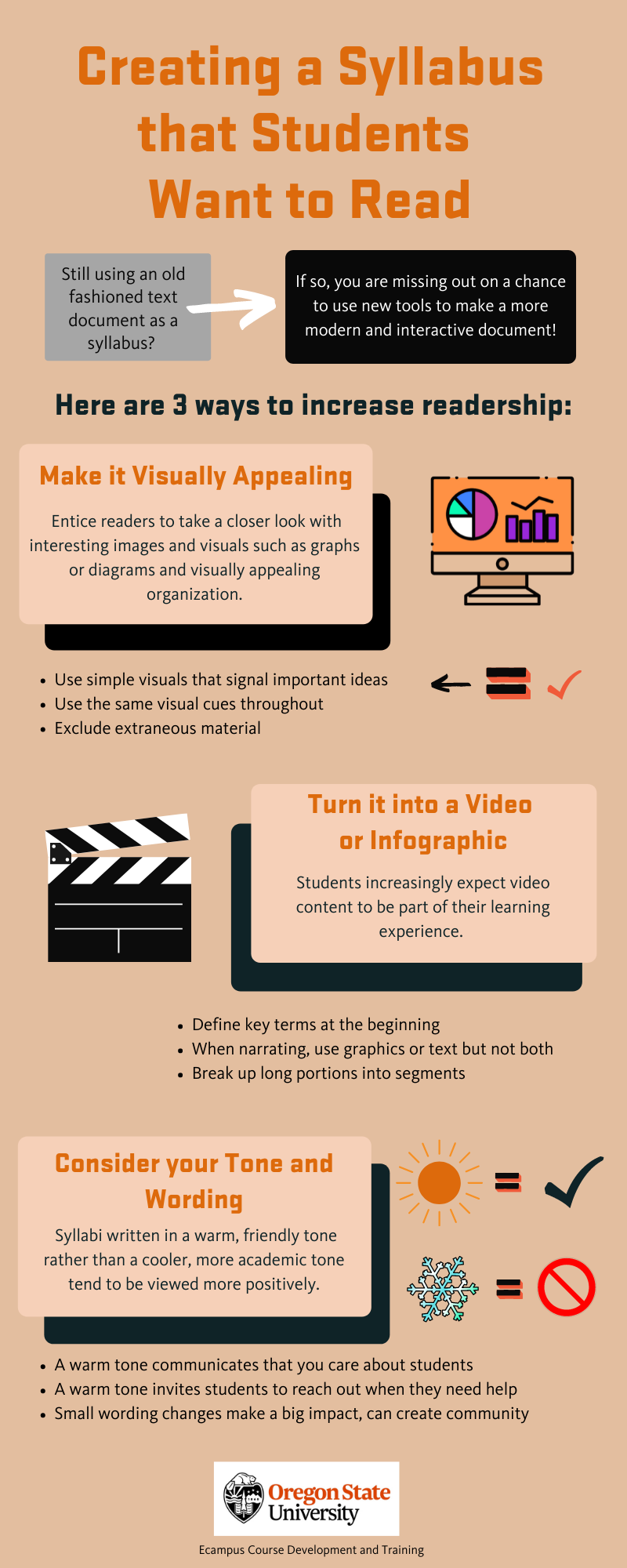
Tricks to creating a syllabus students want to read

In December 2021, CNN published a news story that went viral, featuring a Tennessee professor who hid in his syllabus a combination that led to a locker with a crisp $50 bill for the taking. When he announced at the end of the term that not a single student had claimed the prize, few were actually surprised. Hiding an Easter egg of this sort in the text of your syllabus is certainly a fun idea and a nice bonus for the most diligent student(s) who might find it, but there are other ways to get students to read what could arguably be the most important document in your course.  A course syllabus has traditionally served many overlapping purposes. From an … Creating a Syllabus that Students Want to Read
Course Learning Outcomes – High-Beam or Low-Beam Lights?

The following is a guest blog post from Meilianty Gunawan. Meili completed an Instructional Design internship with OSU Ecampus during Fall 2021. Have you ever driven a car on a highway with no streetlights in the middle of the night? Your first instinct is to turn your car’s high-beam lights on to give you greater visibility on what lies far ahead of you. You are probably fine just by relying on the car’s low-beam lights, but you will not be able to get a clearer picture of the far end of the road as you would get from the high-beam. Bloom’s Taxonomy is a framework used by instructors to develop course learning outcomes. It lays out six cognitive domains (from … Course Learning Outcomes – High-Beam or Low-Beam Lights?

What is the Future of Online Education? Perceptions of Long-term Online Instructors

The changes in higher education precipitated by the COVID-19 pandemic have reignited questions and misconceptions about online education.  This is a time that we should draw on the insights and experience of online faculty. At Oregon State University (OSU) we have a significant number of faculty who have been teaching online for over a decade. In the 2018-2019 academic year, the Ecampus Research Unit interviewed 33 OSU instructors who had taught online for 10 years or more. In a series of interviews, the instructors were asked to reflect on their experiences as an online educator and how their perspectives have changed over time. More information about the broader study can be found on the study website. The final question asked … What is the Future of Online Education? Perceptions of Long-term Online Instructors

Inclusive Teaching Online: A Shared Responsibility

“Educators and learning designers must seek to resolve societal shortcomings, including the inequity of education and opportunity; the lack of social justice; policy issues and their implications; implicit bias in terms of race or ability; as well as layers of equity and inclusion. Building community and bridging divides are goals for all education.” Toward Inclusive Learning Design: Social Justice, Equity, and Community. AECT Research Symposium 2021. This was the underlying premise of a research symposium on learning design in which I participated in the summer of 2021. While this premise emphasizes our responsibility for designing learning experiences that are not only inclusive but just, there is an implicit idea that design alone is not a sufficient condition for inclusivity; we … Inclusive Teaching Online: A Shared Responsibility

Course Design Challenge: Try Subtraction

In your work as an instructor or instructional designer, what kinds of course design problems have you been trying to solve lately? Perhaps there’s a discussion board assignment that you’d like to make more engaging, or maybe there’s a lab activity that students struggle with. According to recent research findings published in the journal Nature, “…people are more likely to consider solutions that add features than solutions that remove them, even when removing features is more efficient” (Meyvis, T. and Yoon, H., 2021). In a course design context, this means we will probably reach for something we can add to our course to fix a problem: a shiny new tool we learned about at a conference, an extra video lecture, … Course Design Challenge: Try Subtraction