
Inspire Blog Tag: ecampus

Reflection Assignments in Math Courses

(image from pxfuel.com) Reflection assignments as an active learning strategy are commonly seen in humanities courses. The purpose of this writing is to share an example of how simple reflection activities can make a huge impact in two math courses. MTH 251 Differential Calculus covers five units, with one exam for each unit, counting 14% of the final grade. Before students attempt to take the unit exam, they are assigned to read textbook readings, watch instructor-created lecture videos, work on Canvas-based homework assignment and Adaptive Learning based practice assignments in Knewton Lab online platform. After assignment due date expires, students are assigned to complete a weekly written homework reflection. The weekly homework and the weekly homework reflection together count for … Reflection Assignments in Math Courses
Don’t Forget the Beret: Getting Ready for a Virtual Trip

People spend more time in virtual worlds than ever before. And educators are leveraging these popular forms of recorded and interactive escapism to increase student engagement. Recently academic departments have begun to experiment with the use of virtual reality (VR) headsets, which have become much easier to use and far less expensive. Headsets can make people feel like they have traveled to a new place, so they are an intriguing new tool for learning. They can create an experience that differs significantly from using a computer to work or play in an online environment. When using a computer to visit an online world, your sense of immersion is affected by many factors, including the quality of video and audio, the … Don’t Forget the Beret: Getting Ready for a Virtual Trip

Reflections on page elements for accessible courses

Introduction The LMS Canvas by Instructure comes with a decent set of styled elements to start with, but diving into the HTML editor is where you can really modify content, giving it a specific look and feel. Recently I have found that I am going to these customized elements more often to help achieve learning outcomes and provide a different look and feel for accessible course pages. It is not limitless, however, or even as open as regular web development would be. Canvas has an HTML Editor Allowlist for elements, styles and classes (though some absent from this list will work if you give it a go!). Many of these are activated by using in-line class or style, but other attributes … Reflections on page elements for accessible courses

Improving Group Work in Asynchronous Courses

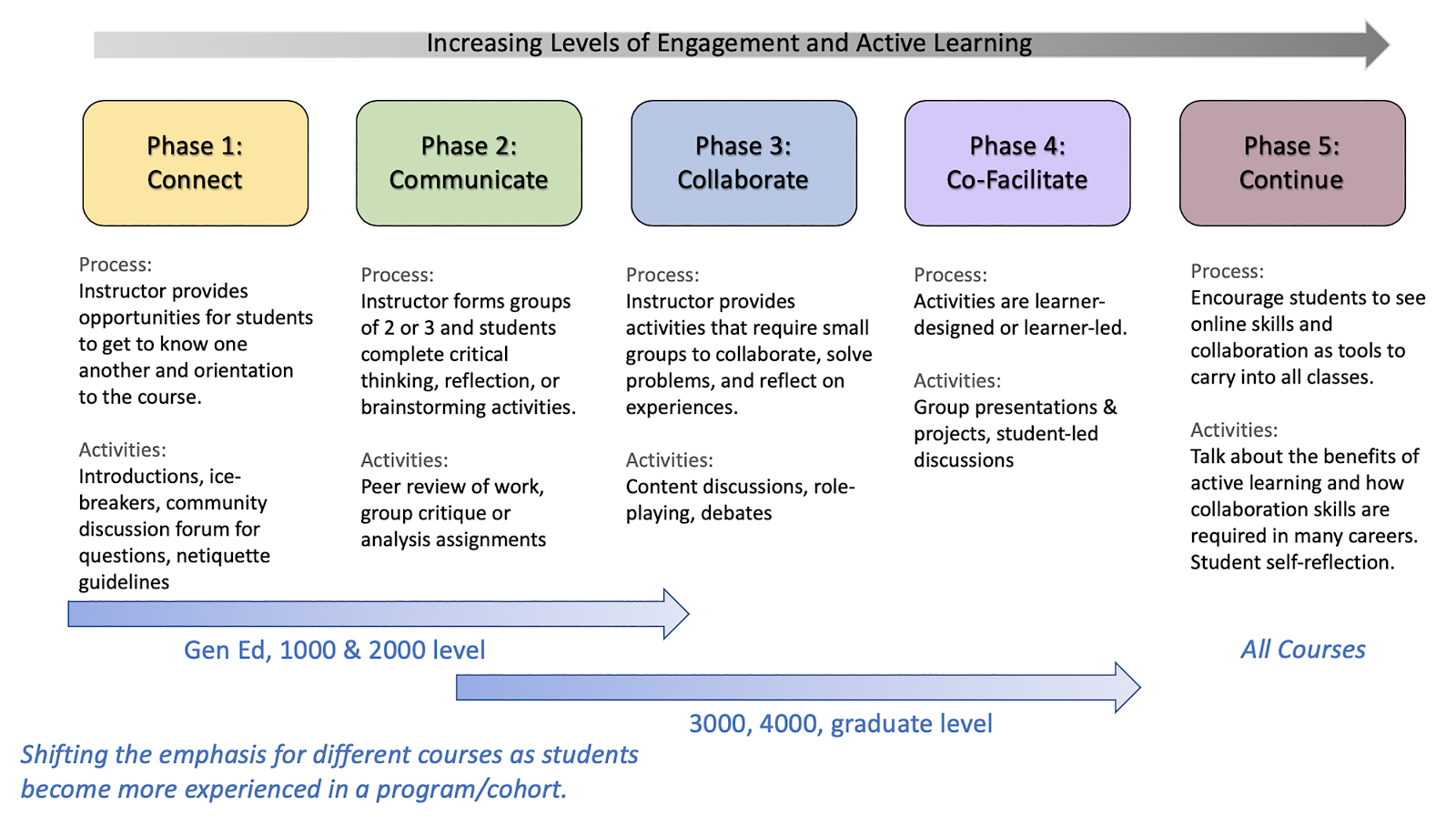
chart of five phases of engagement: connect, communicate, collaborate, co-facilitate, and continue

 Why Group Work Is Important  Love it or hate it, group work is an important part of education. Learning to work cooperatively with diverse people is a core 21st century skill, one which employers increasingly value and expect new workers to have mastered. Experience gathered from group work in educational settings directly transfers to and prepares students for successful collaboration in work teams. By collaborating in teams, students learn a wide range of discrete as well as soft skills that make group work worth the effort, including those below. Technology skills Social skills Self-awareness Empathy Coping with stress Creating work plans and schedules Forecasting needs and hurdles Time management & meeting deadlines Working with difficult personalities Managing & navigating unmet … Improving Group Work in Asynchronous Courses

Let’s Get Active: Adding Active Learning in Your Online Course

By Susan Fein, Instructional Designer, susan.fein@oregonstate.edu In my role as an instructional designer, the faculty I work with are often looking for ways to increase student engagement and add a “wow” factor to their online course. One way to do that is to add or increase active learning practices. Active learning requires students to do something and think about what they are doing, rather than simply listening, as with a passive-learning lecture (Bonwell & Eison, 1991). Active learning brings positive and lasting outcomes to students, including better retention and grasp of concepts, and is particularly evident when students work together to develop solutions (Chickering & Gamson, 1987). Tackling Discussions In 2019, I worked with an instructor developing a biochemistry/biophysics course … Let’s Get Active: Adding Active Learning in Your Online Course