
Inspire Blog Tag: ecampus

Tips for Evaluating Textbooks for Diversity, Equity, and Inclusion

Evaluating Textbooks When selecting a textbook, there are a number of factors to evaluate. In addition to assessing the textbook for appropriate content, one category that I recommend looking at is how inclusive the textbook is. Here are a few guiding questions to ask when evaluating textbooks for inclusion: What is the cost of this textbook? Have you looked for open (free) textbooks, perhaps from the Open Textbook Library or considered writing or adapting your own? Affordability is inclusive. Do the textbook images of people represent diverse cultural heritage and lived experiences? Are the contributions to the field that are highlighted in the textbook from a diverse range of scholars in the field? If not, is there discussion about why … Tips for Evaluating Textbooks for Diversity, Equity, and Inclusion
Assignment Design: Transparency

Assignments are an integral component of the educational experience to guide the teaching and learning processes. In fact, Dougherty (2012) contends that assignments are instructional events that aim to teach for learning, that is “recipes for instructional events— lessons in the best sense— and their main function is to create a context for teaching new content and skills and practicing learned ones.” (p. 23). Assignments as instructional plans provide students with the opportunities to apply concepts they studied in the class. Further, through assignments, students can demonstrate the skills developed in a unit of content in more concrete ways and aligned to the goals of the course. In my consultations with instructors I often hear them raise concerns about course … Assignment Design: Transparency

Learning from Games: Failure Edition

This is the paradox of failure in games. It can be stated like this: We generally avoid failure. We experience failure when playing games. We seek out games, although we will experience something that we normally avoid. (Juul, p. 2) As a continuation from my last blog post considering grades and Self-Determination Theory, I wanted to take a brief side-quest into considering what it means to experience failure. Jesper Juul’s The Art of Failure: An Essay on the Pain of Playing Video Games will provide the main outline and material for this post, while I add what lessons we might learn about feedback and course design in online settings. Dealing with Failure Juul outlines how games communicate through feedback using … Learning from Games: Failure Edition

Intersectionality, Disability, and UDL

Introduction to Intersectionality In 1989, Kimberlé Williams Crenshaw, a lawyer and scholar of Critical Race Theory (CRT), coined the term intersectionality to describe the multiple and layered oppressions experienced by African American women. Over time, this term has been used to describe many aspects of social identity, particularly focusing on race, gender, and class oppression. Intersectionality allows us to consider the impact of multiple oppressions on individuals and groups. For example, asking what it means to be poor in the United States is different from asking what it means to be a poor, Black, woman in the United States, which is different from asking what it means to be a poor, Black, disabled woman in the Southern United States.  Intersectionality … Intersectionality, Disability, and UDL

Adding a New Feedback Loop to Your Online Courses

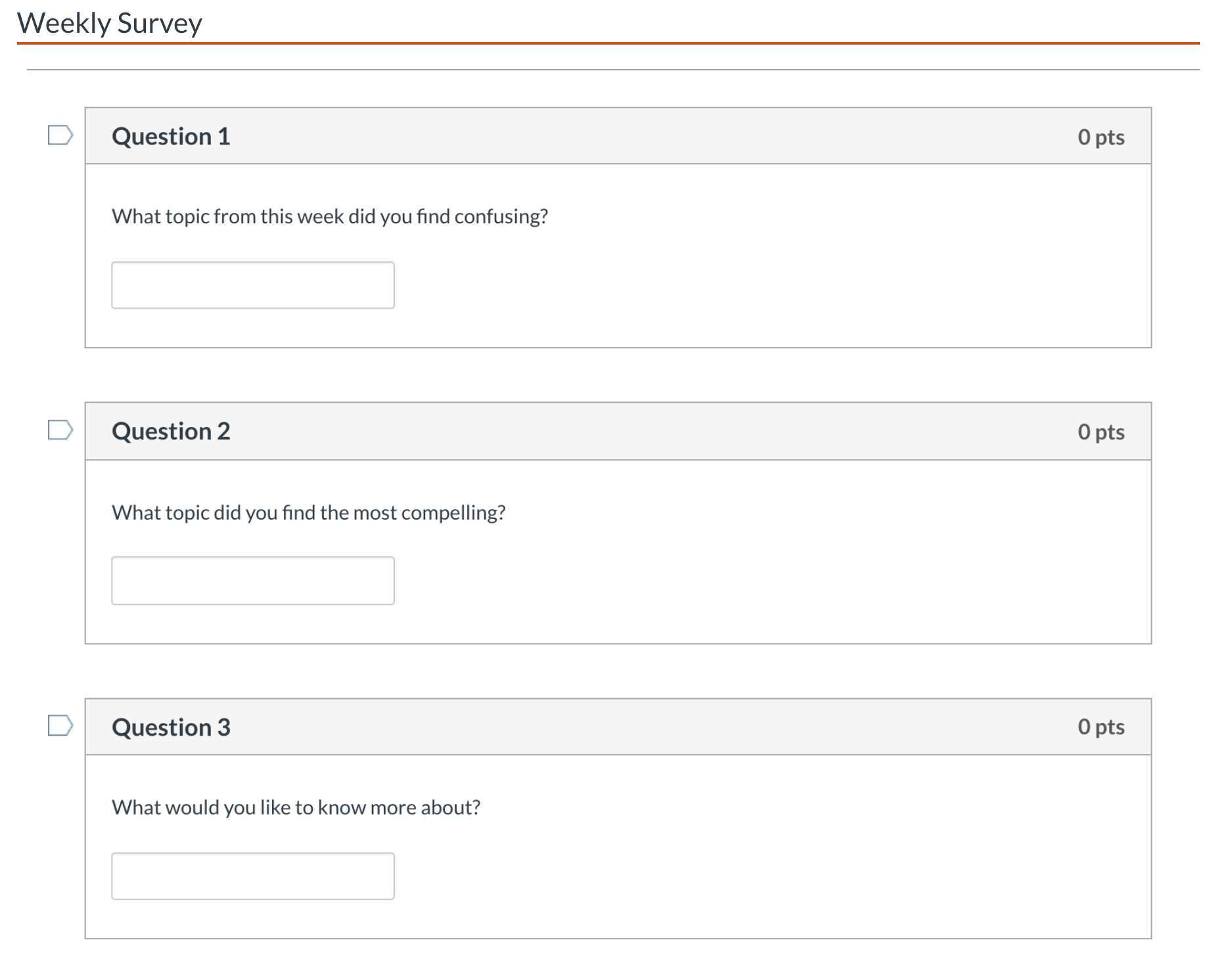
Canvas Survey with Mud Card Questions

New online instructors often express concern about the loss of immediate student feedback they get by teaching in person. These educators count on in-class interaction to help shape their lesson plans in real-time. Student questions, lack of interaction, or even blank looks, help them understand what concepts are difficult for their learners. Others just feel more comfortable with the two-way nature of in-classroom communication. But teaching in an online environment doesn’t have to be mutually exclusive from gauging student interest and comprehension. Mud Cards I was first introduced to the concept of “Mud Cards” or “Muddiest Points” through an open course MIT offered in Active Learning in College-Level Science and Engineering Courses. The instructor described handing out index cards to … Adding a New Feedback Loop to Your Online Courses