
Inspire Blog Category: Resources, Tools & Trends

Improving Group Work in Asynchronous Courses
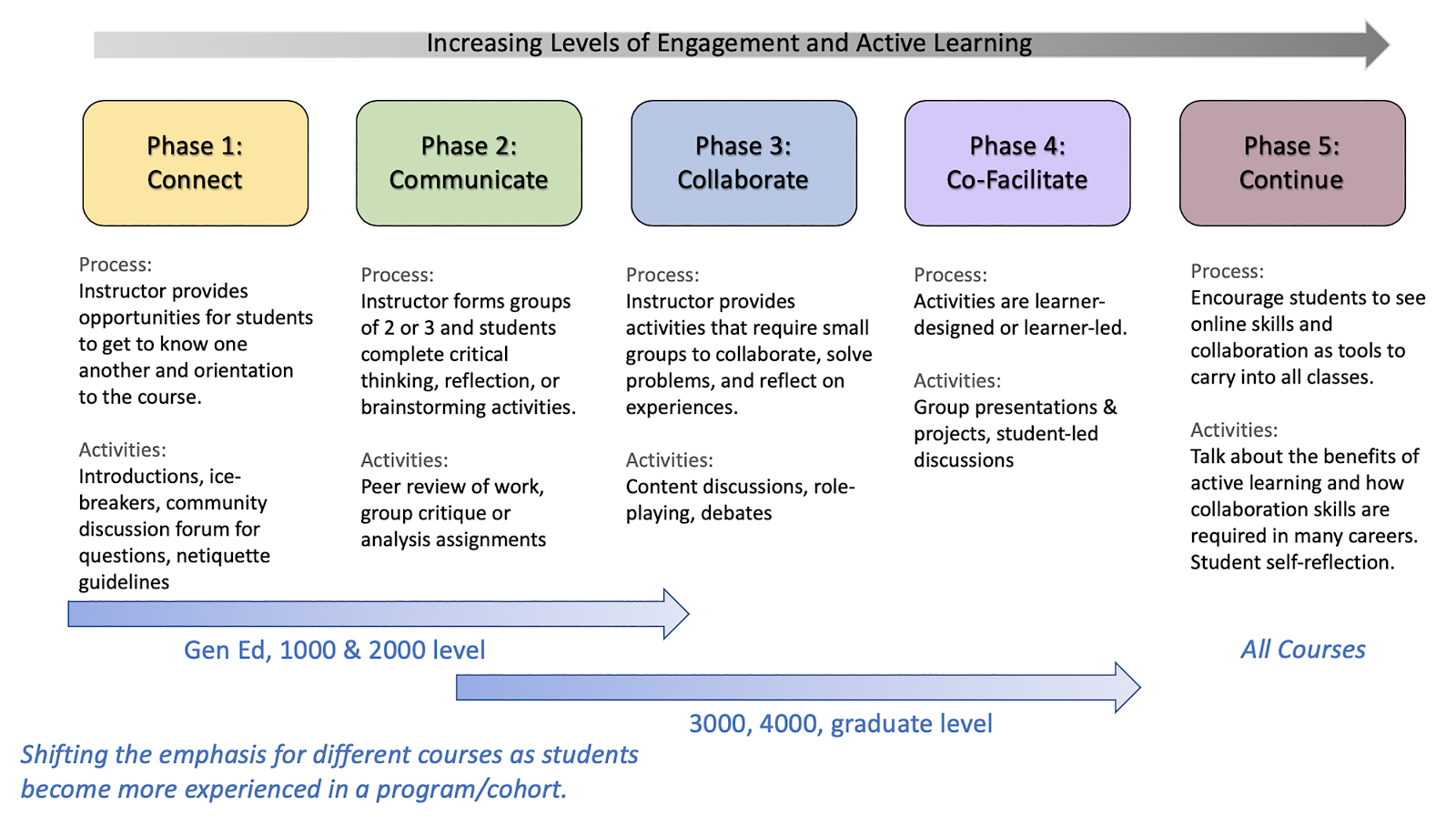
chart of five phases of engagement: connect, communicate, collaborate, co-facilitate, and continue

 Why Group Work Is Important  Love it or hate it, group work is an important part of education. Learning to work cooperatively with diverse people is a core 21st century skill, one which employers increasingly value and expect new workers to have mastered. Experience gathered from group work in educational settings directly transfers to and prepares students for successful collaboration in work teams. By collaborating in teams, students learn a wide range of discrete as well as soft skills that make group work worth the effort, including those below. Technology skills Social skills Self-awareness Empathy Coping with stress Creating work plans and schedules Forecasting needs and hurdles Time management & meeting deadlines Working with difficult personalities Managing & navigating unmet … Improving Group Work in Asynchronous Courses

Let’s Get Active: Adding Active Learning in Your Online Course

By Susan Fein, Instructional Designer, susan.fein@oregonstate.edu In my role as an instructional designer, the faculty I work with are often looking for ways to increase student engagement and add a “wow” factor to their online course. One way to do that is to add or increase active learning practices. Active learning requires students to do something and think about what they are doing, rather than simply listening, as with a passive-learning lecture (Bonwell & Eison, 1991). Active learning brings positive and lasting outcomes to students, including better retention and grasp of concepts, and is particularly evident when students work together to develop solutions (Chickering & Gamson, 1987). Tackling Discussions In 2019, I worked with an instructor developing a biochemistry/biophysics course … Let’s Get Active: Adding Active Learning in Your Online Course

Tips for Evaluating Textbooks for Diversity, Equity, and Inclusion

Evaluating Textbooks When selecting a textbook, there are a number of factors to evaluate. In addition to assessing the textbook for appropriate content, one category that I recommend looking at is how inclusive the textbook is. Here are a few guiding questions to ask when evaluating textbooks for inclusion: What is the cost of this textbook? Have you looked for open (free) textbooks, perhaps from the Open Textbook Library or considered writing or adapting your own? Affordability is inclusive. Do the textbook images of people represent diverse cultural heritage and lived experiences? Are the contributions to the field that are highlighted in the textbook from a diverse range of scholars in the field? If not, is there discussion about why … Tips for Evaluating Textbooks for Diversity, Equity, and Inclusion

Memory: Where All the Magic Happens

Memory plays the central role in learning – it is “the mechanism by which our teaching literally changes students’ minds and brains” (Miller, 2014, p. 88). Thus, understanding how memory works is important for both instructional designers and instructors. According to modern theories, memory involves three major processes: encoding (transforming information into memory representations), storage (the maintenance of these representations for a long time), and retrieval (the process of accessing the stored representations when we need them for some goal or task) (Miller, 2014). Let’s briefly review these processes and see how they may inform our course design and instruction. Encoding – What Is the Role of Attention and Working Memory? How does encoding happen? We receive information from our … Memory: Where All the Magic Happens

Is it okay to use YouTube videos in your course?

Is it okay to use YouTube videos in your course? What about copyright? I get inquiries like this often. Here I’ll share the most common questions from instructors and the answers I provide. Q: Should I be concerned about relying on a link to a YouTube video for essential course content? There are quite a few YouTube videos on a topic I cover in my course, and all of them are better than what I could put together on my own, given the constraints on my time and technical expertise. A: There are several considerations when using YouTube videos:  YouTube videos may be taken down at some later date, and this would be a problem if you are relying on … Is it okay to use YouTube videos in your course?