Inspire Blog Tag: engagement

My Experience with Emojis in Online Courses: Affordances and Considerations
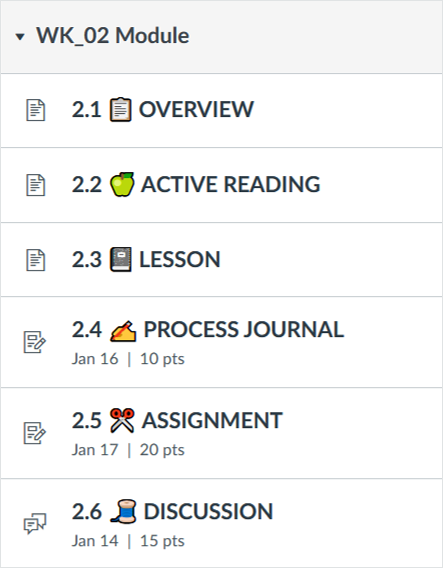
clipboard, green apple, notebook, hand writing with pencil, scissors and spool of thread emojis used in module items

What should you know about emojis if you plan to use them in your online courses? Not being an extremely online person and not, perhaps, of the right generation, I came to emojis later than others and felt uncertain using them. What did these symbols communicate to others, and how would it reflect on me if I used them in my work with instructors and students? Without research-based answers to these questions, I nonetheless began using emojis in online course designs for the purpose of visual wayfinding and for fostering a friendly, playful tone. After several terms of using emojis in this way, I wondered whether they were accomplishing my goals. Now I’d like to share the background on emojis … My Experience with Emojis in Online Courses: Affordances and Considerations
Let’s Get Active: Adding Active Learning in Your Online Course

By Susan Fein, Instructional Designer, susan.fein@oregonstate.edu In my role as an instructional designer, the faculty I work with are often looking for ways to increase student engagement and add a “wow” factor to their online course. One way to do that is to add or increase active learning practices. Active learning requires students to do something and think about what they are doing, rather than simply listening, as with a passive-learning lecture (Bonwell & Eison, 1991). Active learning brings positive and lasting outcomes to students, including better retention and grasp of concepts, and is particularly evident when students work together to develop solutions (Chickering & Gamson, 1987). Tackling Discussions In 2019, I worked with an instructor developing a biochemistry/biophysics course … Let’s Get Active: Adding Active Learning in Your Online Course

Adding a New Feedback Loop to Your Online Courses

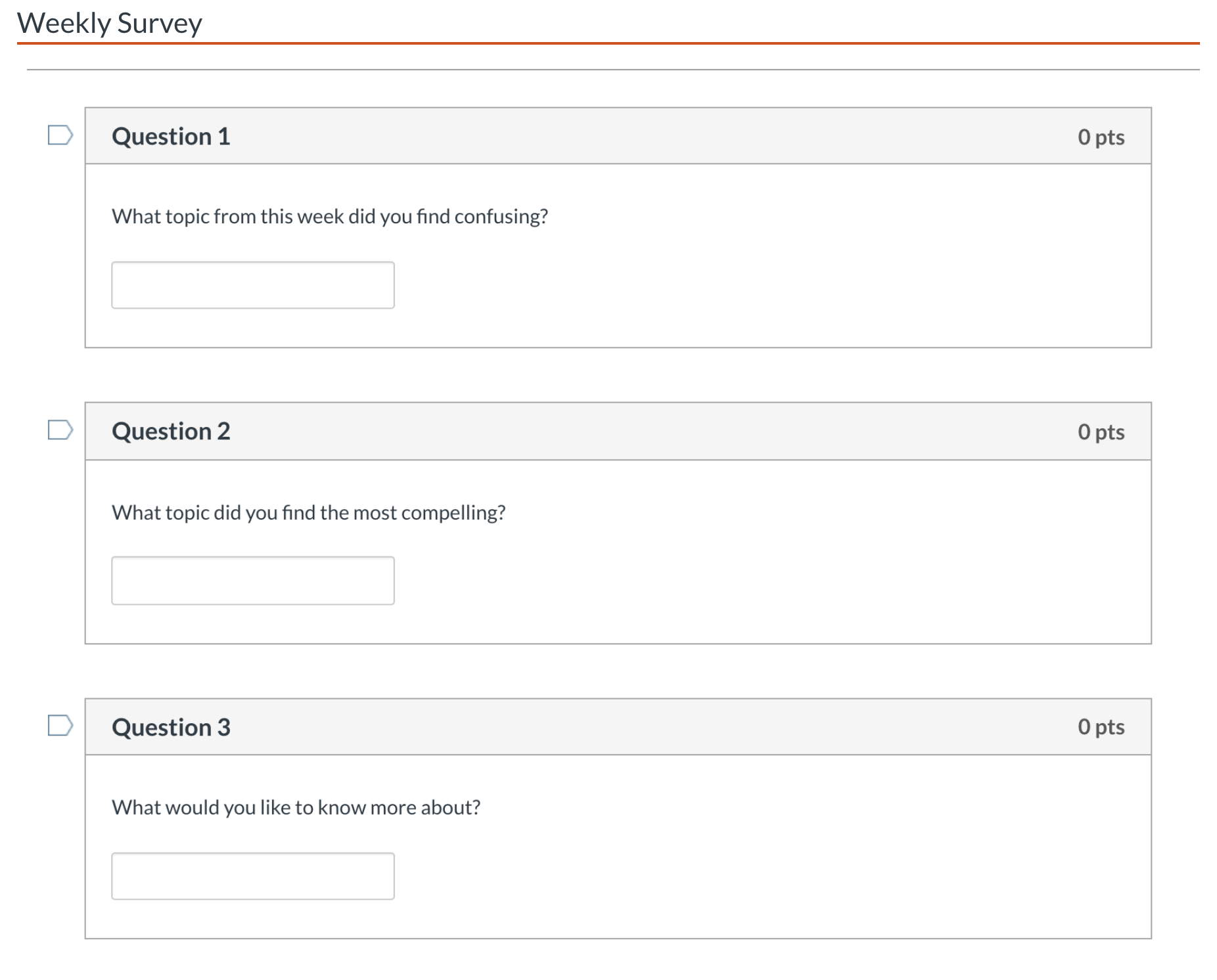
Canvas Survey with Mud Card Questions

New online instructors often express concern about the loss of immediate student feedback they get by teaching in person. These educators count on in-class interaction to help shape their lesson plans in real-time. Student questions, lack of interaction, or even blank looks, help them understand what concepts are difficult for their learners. Others just feel more comfortable with the two-way nature of in-classroom communication. But teaching in an online environment doesn’t have to be mutually exclusive from gauging student interest and comprehension. Mud Cards I was first introduced to the concept of “Mud Cards” or “Muddiest Points” through an open course MIT offered in Active Learning in College-Level Science and Engineering Courses. The instructor described handing out index cards to … Adding a New Feedback Loop to Your Online Courses

Facilitating Active Learning with Zoom

Facilitating Active Learning with Zoom By Christine Scott, Instructional Design Specialist, Oregon State University Ecampus So you managed to get your face-to-face courses up and running remotely in the midst of a global pandemic. You’ve secured your Zoom sessions to avoid unwanted disruptions, your students are in their virtual seats, and you’ve successfully delivered a few lectures. So what’s next? Now that you have students’ attention, you may find that you’re ready to focus on transforming your synchronous session into a space for active learning to take place. It’s no secret that students learn better when they are actively engaged in the learning process. The question is how that translates to a remote Zoom session. Is it even possible to … Facilitating Active Learning with Zoom