
Inspire Blog Category: Tips & Tricks

My Experience with Emojis in Online Courses: Affordances and Considerations
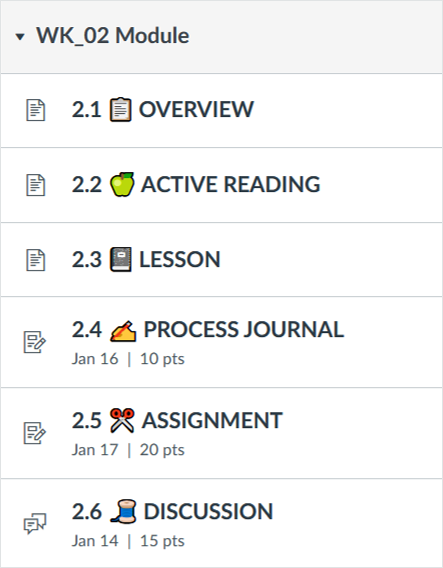
clipboard, green apple, notebook, hand writing with pencil, scissors and spool of thread emojis used in module items

What should you know about emojis if you plan to use them in your online courses? Not being an extremely online person and not, perhaps, of the right generation, I came to emojis later than others and felt uncertain using them. What did these symbols communicate to others, and how would it reflect on me if I used them in my work with instructors and students? Without research-based answers to these questions, I nonetheless began using emojis in online course designs for the purpose of visual wayfinding and for fostering a friendly, playful tone. After several terms of using emojis in this way, I wondered whether they were accomplishing my goals. Now I’d like to share the background on emojis … My Experience with Emojis in Online Courses: Affordances and Considerations

It Takes Two: Fostering Collaborative Faculty-Instructional Designer Relationships for Student-Centered Learning

Introduction Relationships matter for successful collaborative work. Yet, when it comes to online/ blended/hybrid course design, development often begins with a focus on course content, assuming that the collaborative relationship between faculty and instructional designers is secondary to the design process (Tate, 2017). If we care about student success, we must turn our attention to the ways in which effective collaborative relationships among design partners contribute to the course feel — that is, the online learning environment as perceived by students. In our recent OLC presentation, we proposed an interactive strategy for developing collaborative relationships between faculty and instructional designers based on curiosity, enthusiasm, and mutual respect.  Faculty and instructional designers often find themselves at cross-purposes. The design process expects … It Takes Two: Fostering Collaborative Faculty-Instructional Designer Relationships for Student-Centered Learning

Social Annotation as a Learning Tool

“Annotation provides information, making knowledge more accessible. Annotation shares commentary, making both expert opinion and everyday perspective more transparent. Annotation sparks conversation, making our dialogue – about art, religion, culture, politics, and research – more interactive. Annotation expresses power, making civic life more robust and participatory. And annotation aids learning, augmenting our intellect, cognition, and collaboration. This is why annotation matters.”                                            -Kalir and Garcia Annotation  When you think back to your early college years, you may remember your professor assigning a text to annotate. Annotating a text has long been a common task in higher education, one that ideally promotes deeper reading, interaction with, and comprehension of important texts. Annotation assignments vary widely but the traditional paper-based type of annotation … Social Annotation as a Learning Tool

Inviting Art into Online Course Design

How it Begins As an instructional designer one of my most important tasks is to hold an initial meeting  with an instructor, or subject matter expert (SME). During that first opportunity to collaborate on an online course design project the conversation typically focuses on  key course design elements. Commonly we discuss the broad approach to the course, anticipated assignments, narrated lecture needs, assessment, video production and support, the mechanics of the development process and more. Rarely does art come up in the conversation.  Chasing Images Now, that may seem obvious why art is not outwardly discussed. However in the first meeting we do address the topic of look and feel for the course, and images for course banners and any … Inviting Art into Online Course Design

Dimensions for Culturally Responsive Learning Design

At a recent faculty professional development workshop series, I became aware of faculty’s concerns about addressing the learning needs of students from different cultural and linguistic backgrounds. Students with multilingual and multicultural identities are oftentimes perceived as deficient (Almon, 2014; Flores & Rosa, 2015) and might feel they hold an outsider status (Merryfield, 2000). In my personal experience navigating multiple identities that intersect culture and language, and in my work supporting faculty in their learning design and instructional decisions, I began examining ways in which blended and online learning spaces can offer more welcoming opportunities for students. One of these ways is using a cultural lens and mindset towards inclusive learning design.  Culturally Responsive Approaches There have been several culturally … Dimensions for Culturally Responsive Learning Design